Acadia National Park is best known for its rocky coastline, granite mountains, forests, ponds, and historic carriage roads, but its streams and seasonal waterfalls add another dimension to the landscape. After spring snowmelt or periods of heavy rainfall, streams that are normally quiet can come alive, producing scenic waterfalls and cascades across Mount Desert Island.
Unlike the large, year-round waterfalls found in some western U.S. national parks, Acadia’s waterfalls are generally smaller, seasonal, and closely tied to weather conditions. The park’s streams respond quickly to precipitation because many watersheds have relatively small drainage areas, thin soils, and extensive exposed granite. As a result, a waterfall that is barely noticeable one week can become a powerful cascade after several inches of rain. Friends of Acadia describes these as “flashy streams” because their water levels can rise and fall rapidly.
That seasonal character is part of what makes waterfall hunting in Acadia so rewarding. Visitors may encounter a powerful cascade beneath a historic stone bridge in spring, hear water rushing through a forest after a storm, or find the same rocky channel almost completely dry during a prolonged summer drought.
Table of Contents
Quick Reference: Waterfalls in Acadia National Park
| Waterfall/Cascade | Height/Type | Seasonality | Location (Area of Mount Desert Island) | How to Access | Best Time to Visit |
|---|---|---|---|---|---|
| Hadlock Falls | Approximately 40 ft; single main drop | Seasonal flow | Upper Hadlock Brook, near Waterfall Bridge | Waterfall Bridge on the carriage road or Hadlock Brook Trail below it | Spring and after heavy rainfall |
| Man O’ War Brook Falls | Coastal brook waterfall; no confirmed height | Seasonal flow | Somes Sound, near Acadia Mountain | Man O’ War Brook Trail and nearby hiking routes | Spring and after rainfall |
| Canon Brook Cascades | Multiple cascades and granite water slides | Seasonal; strongest during runoff | Southern and eastern slopes of Cadillac Mountain | Canon Brook Trail | Spring and after heavy rainfall |
| Duck Brook Falls | Small waterfalls and stream cascades | Seasonal flow | Near Bar Harbor, at Duck Brook Bridge | Duck Brook Road and historic carriage-road bridge | Spring and after rainfall |
| Chasm Brook Falls | Approximately 25 ft; main waterfall with smaller cascades | Seasonal flow | Along the historic carriage-road network | Carriage-road access near Chasm Brook Bridge | Spring and after heavy rainfall |
| Kurt Diederich’s Falls | Steep seasonal cascade over a granite rock face | Highly seasonal | Near The Tarn, Sieur de Monts area | View from Route 3 near The Tarn | Spring and after heavy rainfall |
| Little No Name Cascade | Small cascade through a narrow granite channel | Seasonal flow | Little Harbor Brook, Amphitheatre area | Amphitheatre carriage-road network | Spring and after rainfall |
| Amphitheatre Cascade | Small brook cascade framed by a historic stone bridge | Seasonal flow | Little Harbor Brook, near Jordan Pond | Amphitheatre Loop carriage road | Spring and after rainfall |
| Otter Creek Cascade | Series of granite cascades and rocky pools | Seasonal; some upper sections dry in summer | Valley between Cadillac and Dorr Mountains | A. Murray Young Trail and nearby connecting trails | Spring and after heavy rainfall |
| Other Seasonal Cascades | Smaller stream cascades; heights vary | Mostly seasonal and rainfall-dependent | Deer Brook, Maple Spring Brook, Bubble Pond and other park trails | Carriage roads and designated hiking trails | Spring and after rainfall |
Hadlock Falls
Hadlock Falls is one of the best-known waterfalls in Acadia National Park. Located on Upper Hadlock Brook in the park’s quiet western section of Mount Desert Island, the waterfall drops approximately 40 feet over a series of granite ledges. Its setting beneath the historic Waterfall Bridge makes it especially scenic, combining flowing water, moss-covered rock, and a stone carriage-road structure.
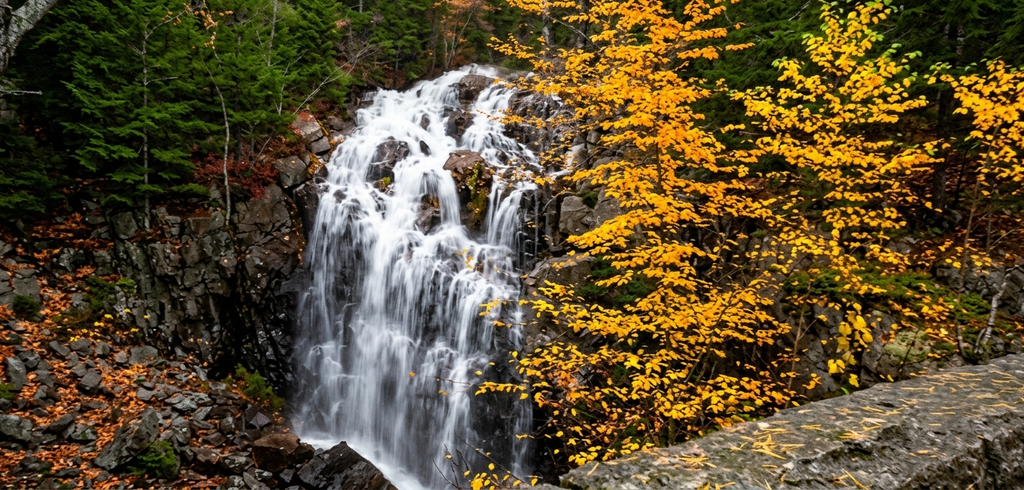
The Waterfall Bridge, built in 1925, was designed as part of Acadia’s historic carriage-road system. The falls can be viewed from the bridge above or from the area below it, where visitors can appreciate the full drop more closely. The surrounding woodland and rugged granite terrain add to the appeal, particularly when the brook is running strongly.
Spring is generally the best season to visit Hadlock Falls, when snowmelt and rainfall increase the flow of Hadlock Brook. After substantial rain, the water can tumble energetically over the rock face; during drier summer periods, the flow may become much weaker. Because access is associated with Acadia’s carriage-road network, visitors should check current park conditions and seasonal carriage-road access before setting out. Rocks beside the brook can also be slippery, so it is best to remain on established routes and viewing areas.
Man O’ War Brook Falls
Man O’ War Brook Falls is a scenic waterfall on the western side of Mount Desert Island, where Man O’ War Brook flows directly into Somes Sound. Unlike waterfalls hidden deep in Acadia’s forests, this cascade reaches the shoreline, creating a distinctive setting against the rocky coast. The brook also has a connection to the island’s maritime history: its freshwater was once collected by sailing vessels anchored in Somes Sound.
The waterfall can be reached from the Acadia Mountain Trail area off Maine Route 102, south of Somesville. A short spur leads toward the brook’s mouth, where the water drops over the final rocky section before entering Somes Sound. The historic trail description identifies this shoreline cascade as the endpoint of the original Man O’ War Brook Trail.
Visitors can also include the waterfall in a longer Acadia Mountain hike. The National Park Service lists Man O’ War Brook Trail as a moderate, 1-mile point-to-point route. Visitors can also choose the NPS-listed 2.8-mile Acadia Mountain Loop, which follows a different route through the area.
Spring and periods following heavy rainfall are generally the best times to see Man O’ War Brook Falls flowing strongly. Like many of Acadia’s smaller waterfalls, its appearance depends on recent precipitation, and the cascade may become much weaker during dry weather. The combination of flowing water, Somes Sound, and the surrounding mountains makes this a rewarding stop for hikers exploring Acadia’s quieter western side.
Canon Brook Cascades
Canon Brook Cascades are among the most varied waterfall features in Acadia National Park. Located along the southern and eastern slopes of Cadillac Mountain, Canon Brook gathers water from several smaller feeder streams before flowing down the mountain’s granite terrain. Rather than forming just one waterfall, the brook creates a series of cascades, rock slides, and small waterfalls along its course.
The Canon Brook Trail provides access to several of these water features. As the trail climbs toward Cadillac Mountain, it follows sections of the brook through a forested landscape of granite ledges, boulders, and rocky stream channels. Several sections of the brook flow over sloping granite, creating small waterfalls and water slides along the mountainside.
The character of Canon Brook changes considerably with the season. During spring snowmelt and after heavy rainfall, multiple channels carry water down the mountain, making the cascades more active and impressive. Some upper sections depend on seasonal runoff, so their flow can diminish or disappear during summer. Lower sections may continue flowing longer, depending on rainfall and groundwater conditions.
Hikers should approach the brook with care, especially when the rocks are wet. The granite surfaces can be extremely slippery, and stream crossings become more hazardous during high water. Staying on the established trail is important when exploring this rugged section of Cadillac Mountain.
Duck Brook Falls
Duck Brook Falls is a series of small waterfalls and cascades located beneath the historic Duck Brook Bridge near Bar Harbor. Rather than a single tall waterfall, Duck Brook flows through a rocky channel and drops over several ledges, creating a succession of cascades beneath and downstream from the bridge. The combination of flowing water, forest surroundings, and historic stone architecture makes this a scenic stop in the northern part of Mount Desert Island.
The most distinctive feature of this location is Duck Brook Bridge, completed in 1929 as part of Acadia’s historic carriage-road system. Designed by architect Charles W. Stoughton, the granite-faced bridge has three arches and stretches approximately 207 feet across the brook. It is considered one of the most architecturally refined bridges in the park. Stone viewing platforms along the bridge provide views of the surrounding landscape, while a staircase on the upstream side leads down toward the brook for a closer look at the bridge and its waterfalls.
Visitors can reach the bridge from Duck Brook Road, accessed from Eagle Lake Road (Route 233). Parking is available near the carriage-road entrance, and the bridge can be reached on foot. The area also connects with the Witch Hole Pond and Paradise Hill carriage-road loops, making it possible to combine waterfall viewing with a longer walk or bicycle ride.
Spring and the days following heavy rainfall generally offer the best water flow at Duck Brook. During drier periods, the cascades may become less pronounced, although the historic bridge remains worth visiting for its design and setting. Visitors should check seasonal road closures before travelling, as the section of Duck Brook Road between the bridge and West Street Extension is normally closed to vehicles from December 1 through April 14.
Chasm Brook Falls
Chasm Brook Falls is one of the notable seasonal waterfalls in Acadia National Park, known for its approximately 25-foot drop beneath the historic Chasm Brook Bridge. Located along the park’s carriage-road network, the waterfall is formed as Chasm Brook flows over a granite ledge and descends through a narrow, rocky channel. The surrounding forest and historic stone bridge create a picturesque setting, particularly when the brook is carrying plenty of water.
The waterfall is closely associated with Chasm Brook Bridge, which was completed in 1926 as part of Acadia’s historic carriage-road system. The bridge provides an excellent viewpoint of the stream and its rocky surroundings. During periods of strong flow, water spills over the ledge below the bridge and continues through a series of smaller cascades. Other sections of Chasm Brook also contain smaller waterfalls and rushing channels, making the area worth exploring beyond the main drop.
Spring is generally the best time to see Chasm Brook Falls, when snowmelt and seasonal rainfall increase the volume of water flowing through the brook. Heavy rain can also bring the waterfall to life at other times of the year. During extended dry spells, however, the flow may decrease considerably.
Access to Chasm Brook Falls is through Acadia’s carriage-road system rather than a conventional roadside trail. The carriage roads are generally closed during the winter and spring mud season, so visitors should check the park’s current access conditions before planning a visit. The rocks around the brook can be slippery, especially after rainfall, and visitors should observe the waterfall from safe, established viewing areas.
Kurt Diederich’s Falls
Kurt Diederich’s Falls is a seasonal waterfall near The Tarn in the Sieur de Monts area of Acadia National Park. The name is informal rather than an official National Park Service designation. The waterfall is particularly noticeable after spring snowmelt and periods of heavy rainfall, when water spills down a steep granite rock face above the pond. The cascade creates an attractive contrast with the surrounding forest and rocky slopes, making it one of the park’s lesser-known waterfall spots.
The waterfall is especially impressive when the brook is carrying a large volume of water. Friends of Acadia describes it as one of the park’s most striking high-water displays and notes that the falling water can be seen from Maine Route 3. Its appearance changes considerably with rainfall, however, and the rock face may carry little or no visible water during extended dry periods.
The nearby Kurt Diederich’s Climb is a historic memorial trail at The Tarn. Built in memory of Kurt Diederich, who died in 1913, the trail features steep granite steps and an engraved stone step near its beginning. It climbs toward Schiff Path on the eastern slope of Dorr Mountain. Although the waterfall and trail share the same name, they are separate features of this area.
For the best chance of seeing the falls, visit during spring or shortly after substantial rainfall. The nearby Sieur de Monts area also offers access to other historic paths and scenic views around The Tarn, making it a worthwhile stop for visitors exploring Acadia’s eastern side.
Little No Name Cascade
Little No Name Cascade is a picturesque waterfall feature along Little Harbor Brook in Acadia National Park. It is located on the Amphitheatre Trail, where the brook passes through a narrow opening in the granite and tumbles over a rocky constriction. Although it is not a tall waterfall, the cascade is particularly attractive because of its rugged rock formations, flowing water, and forested surroundings.
The cascade is situated between two historic carriage-road bridges in the Amphitheatre area. As water squeezes through the narrow granite channel, it creates a series of small drops and rushing sections. The nearby Amphitheatre Bridge, built in 1931, provides another scenic viewpoint along the brook, making this area especially interesting for visitors who enjoy Acadia’s historic stone bridges and natural water features.
Spring is generally the best time to see Little No Name Cascade, when snowmelt and rainfall increase the flow of Little Harbor Brook. After heavy rain, the water moves more forcefully through the granite opening, making the cascade more noticeable. During prolonged dry weather, its flow may become considerably weaker.
Access requires some planning because Little No Name Cascade is reached through Acadia’s carriage-road network. Friends of Acadia specifically advises visitors that this waterfall can only be accessed via the carriage roads and recommends waiting until the spring mud season has ended. The Amphitheatre Loop is a 4.4-mile carriage-road route that passes the nearby Amphitheatre Bridge and Little Harbor Brook Bridge. Visitors should check current carriage-road conditions before setting out and use caution around wet rocks and flowing water.
Amphitheatre Cascade
Amphitheatre Cascade is a scenic waterfall on Little Harbor Brook, framed by the historic Amphitheatre Bridge in Acadia National Park. The cascade is especially attractive because the falling water, granite surroundings, and massive stone bridge come together to create a distinctive landscape. Unlike a tall, uninterrupted waterfall, it is a smaller stream cascade whose appearance changes with the volume of water flowing through the brook.
The most striking feature of this location is Amphitheatre Bridge, completed in 1931. At approximately 245 feet long and 27 feet high, it is the largest of Acadia’s historic carriage-road bridges. Its masonry arch was carefully positioned to preserve two large trees and align with the waterfall, making the bridge an integral part of the natural scenery rather than simply a structure crossing the brook. A viewing balcony at the eastern end of the bridge provides an additional vantage point over the ravine.
Amphitheatre Cascade is located along the historic carriage-road network near Jordan Pond. Visitors can explore the area using the 4.4-mile Amphitheatre Loop, which crosses Amphitheatre Bridge and Little Harbor Brook Bridge. The loop includes several gradual climbs and descents, so visitors should allow enough time to enjoy the route rather than treating it as a short roadside stop.
Spring and periods following heavy rainfall are generally the best times to see the cascade flowing strongly. As with other streams in Acadia, water levels can change quickly, and the waterfall may become less noticeable during dry weather. Since access is through the carriage-road system, visitors should check current park conditions and wait until the spring mud-season closures have ended before planning their visit.
Otter Creek Cascade
Otter Creek Cascade is a seasonal series of waterfalls and flowing-water features in the valley between Cadillac and Dorr Mountains in Acadia National Park. Unlike a single, clearly defined waterfall, this area contains several cascades along Otter Creek and its tributaries. Water flows over sloping granite, drops into rocky pools, and passes through narrow channels surrounded by forest.
Otter Creek gathers water from a relatively large drainage area, with its farthest headwater located behind the South Ridge Cadillac Trail sign near the summit parking area. The creek and its tributaries form seasonal cascades and flowing-water features across the valley, particularly after spring snowmelt and heavy rainfall.
The A. Murray Young Trail follows Otter Creek toward the mountain notch between Cadillac and Dorr Mountains. From this area, hikers can connect with the Canon Brook Trail, which climbs the southern slope of Cadillac Mountain alongside Canon Brook. This makes the surrounding valley an interesting area for exploring several different streams and cascades during one outing.
Spring is the best season to explore Otter Creek Cascade, particularly during snowmelt and after heavy rainfall. Some of the upper streams depend on seasonal runoff and may lose much of their flow by the warmer months. Visitors should remain on established trails and take extra care on wet granite surfaces, which can become slippery.
Other Seasonal Cascades and Waterfall Spots in Acadia
Beyond Acadia’s better-known waterfalls, the park contains numerous smaller cascades and temporary waterfalls that appear along mountain streams, carriage roads, and forest trails. Many of these features do not have official names and may be visible only during spring runoff or after substantial rainfall. Exploring these lesser-known locations can reveal a different side of Acadia’s landscape, especially when water is flowing over the park’s exposed granite slopes.
One worthwhile place to look is Deer Brook, particularly near the historic Deer Brook Carriage Road Bridge. Built in 1925, the stone bridge crosses the brook near the northern end of Jordan Pond. After heavy rainfall, the stream and nearby rocky channels can produce attractive cascades. The bridge itself is also a good example of the historic engineering found throughout Acadia’s carriage-road system.
Maple Spring Brook is another interesting watercourse on Mount Desert Island. The stream runs near Hemlock Bridge, a historic carriage-road bridge built in 1924. Its water is influenced by springs on the slopes of Sargent Mountain, and the brook can continue flowing during periods when some smaller seasonal streams have weakened. The surrounding Maple Spring Trail area also contains several small waterfalls and flowing-water sections, making it worth exploring beyond a single viewpoint.
Visitors can also look for temporary cascades along the Sluiceway Trail, Razorback Trail, Emery Path, and Bubble Pond Carriage Road. Other promising locations include Hadlock Brook below Lower Hadlock Pond and the section of Canon Brook Trail between the Dorr Mountain South Ridge and A. Murray Young trails. The Gorge Path, Giant Slide, A. Murray Young Path, and Hunters Brook Trail are additional places where flowing streams can be heard and observed, particularly after rain.
These smaller waterfalls are highly dependent on local weather and stream conditions. Some may appear for only a short time after a storm, while others flow more consistently during spring snowmelt. They are not all established waterfall destinations with marked viewpoints, so visitors should remain on designated trails and carriage roads rather than crossing fragile vegetation or climbing wet granite in search of a closer view.
Best Time to See Waterfalls in Acadia National Park
Spring is generally the best time to see waterfalls in Acadia National Park, particularly from April through early June. During this period, melting snow and seasonal rainfall increase the flow of streams across Mount Desert Island. Small brooks that remain quiet during much of the year can turn into active cascades, with water rushing over granite ledges, through narrow channels, and beneath historic carriage-road bridges.
Spring: The Best Season for Waterfalls
Spring snowmelt is one of the main sources of water for Acadia’s seasonal waterfalls. Combined with frequent rainfall, it produces some of the strongest flows of the year. Hadlock Falls, Chasm Brook Falls, Canon Brook Cascades, and the waterfalls along Little Harbor Brook are particularly worth exploring during this period.
However, spring conditions vary from year to year. The amount of snow remaining, recent rainfall, and temperature changes all influence how much water flows through the streams. Visitors should also remember that Acadia’s carriage roads are commonly closed during spring mud season to prevent damage to their gravel surfaces. Wait until the National Park Service announces that the roads have reopened before visiting waterfalls that require carriage-road access.
After Heavy Rain: Another Good Time to Visit
You do not necessarily have to visit in spring to see Acadia’s waterfalls flowing strongly. Periods of heavy rainfall can bring many of the park’s smaller streams and cascades back to life, even during summer or fall. Because Acadia has relatively small watersheds, thin soils, and extensive exposed granite, its streams respond quickly to precipitation.
Friends of Acadia describes these as “flashy streams” because their water levels rise and fall rapidly. A waterfall that appears weak or nearly dry during a sunny period may become much more impressive shortly after substantial rainfall. For this reason, checking recent weather conditions can be just as useful as choosing a particular month.
Summer and Fall: More Variable Water Flow
By summer, many of Acadia’s smaller waterfalls begin to lose water as spring snowmelt ends and streams receive less consistent runoff. Some cascades may shrink to a trickle or disappear during extended dry periods. However, waterfalls fed by springs or larger drainage areas may continue flowing longer than those dependent mainly on seasonal runoff.
Fall can offer another opportunity to see flowing waterfalls, particularly after autumn rainstorms. Water levels remain unpredictable, though, and a dry spell can leave even well-known cascades with very little water. Visitors planning a fall trip should check recent rainfall rather than assume that every waterfall will be flowing.
Check Trail and Carriage Road Conditions Before Visiting
Before heading out to see waterfalls in Acadia National Park, check current trail and carriage road conditions. Heavy rain, snowmelt, and seasonal maintenance can affect access, while some routes may be temporarily closed because of weather or trail work. The National Park Service regularly updates its alerts and closures, so visitors should check the official park website before setting out.
Several notable cascades, including Chasm Brook Falls, Little No Name Cascade, and Amphitheatre Cascade, are accessed through the carriage-road network. Hadlock Falls can be viewed from Waterfall Bridge or from the Hadlock Brook Trail below the bridge. Visitors should also be prepared for wet, slippery granite surfaces and uneven terrain around streams and cascades.
For a safer visit, wear sturdy footwear with good traction, stay on established trails, and avoid climbing on wet rocks. Water levels and conditions can change quickly after rainfall, so use caution near flowing water and steep stream banks.