Joshua Tree National Park is known for its striking desert landscapes, enormous granite boulders, and distinctive Joshua trees. But beneath the rocks, among the desert shrubs, and across its rugged mountain terrain lives a variety of wildlife that visitors should treat with caution. Several animals found in the park are venomous, including rattlesnakes, scorpions, and black widow spiders. Honey bees can also become a nuisance around campgrounds and water sources, while coyotes and mountain lions present different risks if approached or disturbed.
Most visitors explore Joshua Tree without encountering a dangerous animal. However, the desert environment requires a little awareness, particularly when hiking, climbing, or camping. Knowing which animals live here, where they are likely to be found, and how to respond to an encounter can help you avoid unnecessary risks and enjoy your visit safely.
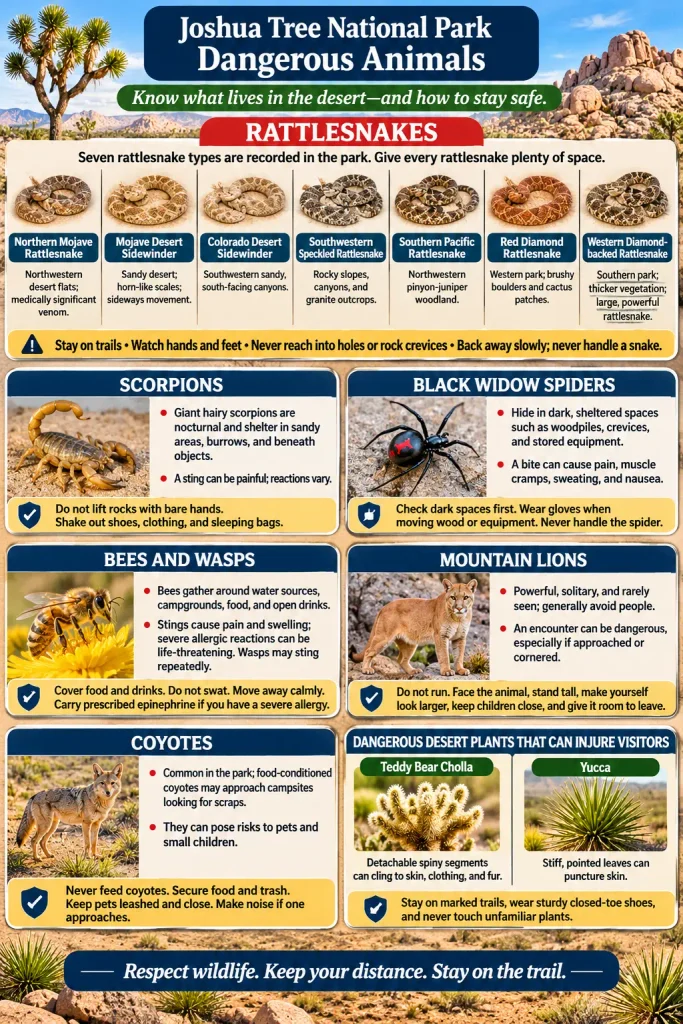
Table of Contents
Rattlesnakes
The National Park Service records 26 snake species in Joshua Tree National Park, including seven rattlesnake types. These venomous snakes occur in different habitats across the park, from sandy desert flats to rocky slopes and canyons. Encounters with visitors are relatively uncommon because rattlesnakes generally avoid human activity and rely on camouflage to remain hidden. Most defensive bites happen when a snake is accidentally stepped on, approached too closely, or disturbed beneath rocks or vegetation.
Although rattlesnakes usually try to avoid confrontation, their bites can cause serious medical complications. The severity of envenomation varies by species and the amount of venom injected, but every suspected rattlesnake bite requires immediate medical attention. The following are the seven rattlesnake types recorded in Joshua Tree National Park.
Northern Mojave Rattlesnake
The Northern Mojave Rattlesnake (Crotalus scutulatus scutulatus) is one of the most medically important venomous snakes in the American Southwest. In Joshua Tree National Park, it occurs along the northwestern edge of the park, primarily in desert flats. Its coloration is usually greenish, gray, or brown, allowing it to blend into the dry desert ground.
What makes this rattlesnake particularly concerning is its venom. Some populations produce venom containing Mojave toxin, a powerful neurotoxic component that can interfere with normal nervous system function. Depending on the snake and the bite, symptoms may include weakness, difficulty swallowing, vision disturbances, and breathing problems. Other venom components can also cause tissue damage.
A bite from a Northern Mojave Rattlesnake requires immediate emergency medical attention, even if the initial pain or swelling seems limited. Visitors should never approach or attempt to identify one at close range.
Mojave Desert Sidewinder
The Mojave Desert Sidewinder (Crotalus cerastes cerastes) is a relatively small rattlesnake recognized by the horn-like scales above its eyes and its distinctive sideways movement across loose sand. It is commonly associated with sandy desert habitats, although it may occasionally be found in rocky areas.
Its sideways movement helps it travel across loose, hot sand while leaving a characteristic series of curved tracks. The snake often remains partially buried in sand, waiting for small animals to pass nearby. Its pale tan or sandy coloration makes it particularly difficult to spot in its natural surroundings.
Despite its small size, the Mojave Desert Sidewinder is venomous. A bite can cause significant pain, swelling, and other symptoms associated with rattlesnake envenomation. Visitors exploring sandy trails or desert washes should watch where they step and avoid reaching into areas they cannot see clearly.
Colorado Desert Sidewinder
The Colorado Desert Sidewinder (Crotalus cerastes laterorepens) is another form of sidewinder found in Joshua Tree National Park. It is associated with sandy, south-facing canyons in the southwestern part of the park. Like the Mojave Desert Sidewinder, it has small horn-like scales above its eyes and moves using a characteristic sideways motion.
Its sandy coloration provides effective camouflage against the desert floor. The snake usually avoids human activity and spends much of its time concealed in suitable shelter or waiting for prey. However, its ability to blend into the ground means hikers and campers may overlook it.
The Colorado Desert Sidewinder is venomous, and its bite can cause pain, swelling, and tissue-related complications. Although it is relatively small compared with larger rattlesnakes, it should never be treated as harmless. Give it plenty of room if encountered and allow it to move away without interference.
Southwestern Speckled Rattlesnake
The Southwestern Speckled Rattlesnake (Crotalus mitchelli pyrrhus) is well adapted to the rocky terrain of Joshua Tree National Park. It commonly inhabits rocky slopes, canyons, and granite outcrops, where its body pattern blends with the surrounding stones. Its coloration varies considerably, often showing a mixture of gray, tan, pink, or brown speckles.
This camouflage makes the snake especially difficult to distinguish from the rocks around it. Hikers climbing over boulders or exploring narrow rocky passages may unknowingly approach one resting in a sheltered crevice. It is generally more concerned with avoiding threats than confronting people, but it can defend itself if disturbed.
Its venom can cause considerable pain, swelling, and tissue injury. The risk is particularly relevant to visitors who climb or scramble over rocks without checking where they place their hands and feet. Avoid reaching into gaps between boulders, even when the area appears empty.
Southern Pacific Rattlesnake
The Southern Pacific Rattlesnake (Crotalus oreganus helleri) occurs in the northwestern part of Joshua Tree National Park, particularly in pinyon-juniper woodland habitat. It usually has a brown, gray, or olive background with darker blotches along its back, although its appearance can vary depending on the individual and surrounding environment.
Like other rattlesnakes, it relies on camouflage to remain concealed from predators and prey. It may shelter among rocks, vegetation, and other protected areas, making encounters possible along trails that pass through its preferred habitat.
Its venom can produce serious effects, including pain, swelling, tissue damage, and disturbances in blood clotting. A bite should always be treated as a medical emergency. Visitors should remain alert around rocky woodland trails and avoid stepping over objects without first checking the other side.
Red Diamond Rattlesnake
The Red Diamond Rattlesnake (Crotalus ruber) is one of the more recognizable rattlesnakes in Southern California because of its reddish or brick-colored body. Dark diamond-shaped markings may run along its back, although the pattern can be less distinct in some individuals. In Joshua Tree, it is associated with brush-covered granite boulders and cactus patches, particularly in the western part of the park.
This snake generally prefers areas where rocks and vegetation provide shelter. Its coloration helps it blend into the reddish desert landscape, especially around granite formations and dry shrubs. Visitors exploring boulder fields or walking close to dense desert vegetation should be careful not to disturb hidden snakes.
The Red Diamond Rattlesnake is venomous, and its bite can cause severe pain, swelling, and tissue injury. Like other rattlesnake bites, the severity can vary, but immediate medical evaluation is essential.
Western Diamond-backed Rattlesnake
The Western Diamond-backed Rattlesnake (Crotalus atrox) is a large, heavy-bodied rattlesnake recognized by the dark diamond-shaped patterns along its back and the black-and-white bands near the end of its tail. It is found in the southern part of Joshua Tree National Park, particularly in areas with relatively thick vegetation.
Its size and powerful venom make it a snake visitors should take seriously. A bite can cause intense pain, swelling, bleeding problems, and significant tissue damage. Although this species is not evenly distributed throughout the park, it may occur in suitable desert habitat.
Western Diamond-backed Rattlesnakes generally avoid people when given the opportunity. However, they may defend themselves if stepped on, cornered, or accidentally approached. Visitors should watch carefully around shrubs, rocks, and other places where a large snake could remain hidden.
How to Avoid Rattlesnake Bites
Regardless of the species, the safest approach is to give every rattlesnake plenty of space. Stay on established trails, wear sturdy closed-toe shoes, and watch where you place your hands and feet, particularly around rocks, shrubs, and desert washes. Use a flashlight when walking around campsites after dark, and never reach blindly beneath rocks or into crevices.
If you encounter a rattlesnake, stop, keep your distance, and allow it to move away. Do not try to handle it, move it off a trail, or kill it. If someone is bitten, seek emergency medical care immediately. Joshua Tree National Park advises visitors to slowly return to their vehicle and head directly to the nearest hospital while keeping their heart rate as low as possible. Do not cut the wound, suck out venom, apply ice, or use a tourniquet.
Scorpions
Scorpions are among the venomous creatures visitors may encounter in Joshua Tree National Park. One of the largest species found in the park is the Giant Hairy Scorpion (Hadrurus hirsutus), a desert-dwelling scorpion adapted to the region’s hot, dry environment. Reaching about 5.5 inches in length, it has a pale yellow to olive-brown body and a distinctive hairy appearance. Although its sting is generally comparable to that of a wasp, it can still cause pain and discomfort, so visitors should never attempt to handle it.
The Giant Hairy Scorpion is most commonly associated with sandy desert habitats, where it can dig burrows and shelter beneath rocks or other objects. It is nocturnal, meaning it is most active after dark when temperatures are cooler. During the day, it usually remains hidden to avoid the desert heat. Visitors camping or hiking after sunset should be particularly careful around rocks, crevices, and areas where scorpions may be sheltering.
A sting from this scorpion can cause immediate pain, along with local swelling, redness, or tenderness. Serious reactions are less common, but the effects can vary depending on the person and the amount of venom injected. Children and people who develop an allergic reaction or severe symptoms should receive prompt medical attention.
To reduce the chance of a sting, avoid reaching into dark crevices or lifting rocks with bare hands. Shake out shoes, clothing, and sleeping bags that have been left outside, especially when camping. If you spot a scorpion, leave it alone rather than trying to catch or move it.
Black Widow Spiders
Western black widow spiders (Latrodectus hesperus) live in the desert habitats of Joshua Tree National Park. They are venomous and can deliver a medically significant bite, although they generally avoid people and bite mainly when trapped, pressed, or disturbed. Visitors are more likely to encounter them around sheltered areas than out in the open desert.
Black widows often build irregular, tangled webs in dark, protected spaces. Look for them beneath rocks, inside woodpiles, around stored equipment, in sheds, and near older structures. Their webs may be close to the ground, making them easy to overlook when setting up camp or moving equipment. Female black widows are usually shiny black, with a distinctive red or orange hourglass marking on the underside of the abdomen.
A bite may initially feel like a small pinprick, so it is not always immediately obvious. However, the venom can cause more widespread symptoms, including significant pain, muscle cramps, sweating, nausea, and abdominal discomfort. Reactions vary, and a suspected black widow bite should be taken seriously, particularly if symptoms develop or the person bitten is a child.
Avoid putting your hands into dark gaps, beneath rocks, or inside woodpiles without checking first. Wear gloves when handling firewood or moving stored equipment, and inspect shoes and clothing left on the ground. If you see a black widow or its web near your campsite, do not handle the spider; give it space and move away.
Bees and Wasps
Bees and wasps can be an unexpected hazard in Joshua Tree National Park, particularly around campgrounds, picnic areas, and places where water and food are available. Honey bees become especially noticeable during hot, dry weather when they search for moisture to cool their hives. The National Park Service identifies Jumbo Rocks Campground, Keys View, and Cholla Cactus Garden as areas where visitors may encounter high concentrations of bees. They may approach open drinks, food, or other moisture sources around campsites. Although honey bees generally sting when threatened or disturbed, getting too close to a swarm or hive can result in multiple stings.
A bee sting usually causes immediate pain, redness, itching, and swelling around the affected area. For most people, these symptoms remain local and improve over time. However, someone with a bee-sting allergy can experience a severe reaction called anaphylaxis, which requires emergency medical treatment. Multiple stings can also be dangerous, even for people without a known allergy.
Wasps may also be encountered around food, trash, and sheltered areas. Unlike bees, some wasps can sting repeatedly. Avoid swatting at either insect or making sudden movements near a swarm. Move away calmly, keep food and drinks covered, and dispose of trash in designated containers. If bees gather around your vehicle, keep the windows closed until they move away. Visitors with a known severe allergy should carry their prescribed epinephrine and know how to use it.
Mountain Lions
Mountain lions (Puma concolor), also known as cougars or pumas, are elusive predators found in the mountainous habitats of Joshua Tree National Park. Although they occur in the park, sightings are uncommon because these solitary cats generally avoid human activity. They are most likely to be active during cooler hours, particularly around dawn, dusk, and nighttime. Their ability to move quietly through rugged terrain and remain hidden makes them difficult to spot.
Mountain lions prefer remote areas with rocky terrain, rugged slopes, and enough vegetation or cover to approach prey without being noticed. Their natural prey includes deer and other small to medium-sized animals. Because they are elusive, visitors may travel through suitable mountain lion habitat without ever seeing one.
Although attacks on people are rare, a mountain lion can be dangerous because of its size, strength, and hunting ability. The risk is greater if someone approaches the animal, gets too close to a den or young cubs, or runs away and triggers a chase response. Children and small pets are particularly vulnerable, so keep children close and pets under control while exploring the park.
If you encounter a mountain lion, do not run or turn your back on it. Stand your ground, face the animal, make yourself appear larger by raising your arms, and speak firmly. Pick up small children without bending down if possible. Give the animal room to leave, and if it approaches, act aggressively by making noise and throwing objects toward it. Never approach a mountain lion for a photograph or attempt to feed it.
The National Park Service advises visitors to keep children close, avoid approaching mountain lions, and report sightings to a park ranger.
Coyotes
Coyotes (Canis latrans) are common in the desert landscapes of Joshua Tree National Park. They may be seen crossing roads, moving through open desert, or searching for food near campsites. Although they generally avoid people, their behavior can change when they become accustomed to human food.
Repeated feeding can cause coyotes to lose their natural fear of humans, encouraging them to approach campsites, picnic areas, and vehicles in search of scraps. These food-conditioned animals may behave unpredictably, particularly around small children and pets. Even when a coyote appears calm or familiar with people, it remains a wild predator and should never be approached or fed.
If a coyote approaches too closely, make yourself appear larger, make loud noises, and give it a clear route to move away. Keep pets on a leash, supervise small children, and store food, pet food, and trash securely. Never approach a coyote for photographs, and report animals that behave aggressively or repeatedly approach people to a park ranger.
Meri recommendation: In dono sections ko ab isi form mein rakho. Rattlesnakes mein species descriptions apni jagah hain, jabki Coyotes mein habitat, food-conditioning behavior aur visitor safety alag-alag information provide karte hain. Conclusion add karne ki zaroorat nahi hai.
Dangerous Desert Plants That Can Injure Visitors
Not all hazards in Joshua Tree National Park come from animals. Some desert plants have sharp spines or rigid leaves that can cause painful injuries if visitors brush against them or accidentally touch them. Two plants worth watching for are the Teddy Bear Cholla and yucca.
Teddy Bear Cholla: Despite its soft, fuzzy appearance, this cactus is covered in clusters of sharp spines. Its stem segments can detach easily when brushed against, attaching themselves to clothing, skin, or even an animal’s fur. The spines are difficult to remove and can cause painful puncture wounds. Keep a safe distance when walking near cholla patches, and watch where you step, particularly along narrow trails.
Yucca: Joshua Tree’s desert environment also supports several yucca species with stiff, pointed leaves. Their sharp tips can puncture skin and cause injuries, especially when visitors walk too close or move through dense vegetation. Be particularly careful when hiking off-trail or navigating around plants in low-light conditions.
Stay on established trails and avoid touching or stepping over unfamiliar desert plants. Wear sturdy footwear and watch your surroundings when walking through areas with dense cactus or yucca growth. These simple precautions can help prevent painful injuries during your visit.
Emergency Information for Wildlife Encounters
A wildlife encounter in Joshua Tree National Park can become a medical emergency if someone is bitten, stung, or injured. Knowing how to respond and where to get help is particularly important because cell phone reception is unreliable in many parts of the park.
Snakebites: If a rattlesnake bites you, move away from the snake and seek emergency medical care immediately. Keep calm, limit unnecessary movement, and slowly return to your vehicle if you can do so safely. The National Park Service advises visitors to drive directly to the nearest hospital while keeping their heart rate as low as possible. Do not cut the wound, attempt to suck out venom, apply ice, or use a tourniquet. Never try to catch or kill the snake.
Scorpion stings and spider bites: Move away from the animal and avoid further contact. Seek medical advice if you experience severe pain, muscle cramps, spreading symptoms, or an unusual reaction. Children and anyone developing serious symptoms should receive prompt medical attention.
Bee and wasp stings: Move away from the insects without swatting at them. A person experiencing difficulty breathing, facial or throat swelling, dizziness, or other signs of a severe allergic reaction needs emergency medical attention. Anyone with a known severe allergy should carry their prescribed epinephrine.
Mountain lion encounters: Do not run or turn your back on the animal. Face it, stand tall, make yourself look larger, and speak firmly. Keep children close and give the mountain lion room to leave.
For an immediate emergency, call 911 if you have cell service. The National Park Service also identifies emergency phones at the Indian Cove Ranger Station, Cottonwood Visitor Center, and the Intersection Rock parking area near Hidden Valley Campground. If your phone has no reception, contact a park ranger or use an available emergency phone.
The nearest hospital listed by the National Park Service is Hi-Desert Medical Center in Joshua Tree, California. Because travel from remote areas of the park can take time, visitors should seek medical attention immediately after a venomous snakebite or any serious wildlife-related injury rather than waiting for symptoms to worsen.
Before visiting, check the National Park Service’s Alerts & Conditions page for current closures and safety updates.