Joshua Tree National Park is home to a remarkable variety of desert wildlife and plant life, including several species facing serious threats to their survival. Although the park’s harsh desert environment supports animals and plants adapted to extreme conditions, habitat loss, drought, climate change, disease, and other environmental pressures continue to affect some of its most vulnerable species. Among them are the Mojave desert tortoise, triple-ribbed milkvetch, and Parish’s daisy, all of which receive federal protection under the Endangered Species Act.
These species play important roles in the park’s desert ecosystems, but their survival depends on the protection of suitable habitats and continued conservation efforts. Understanding which endangered and threatened species live in Joshua Tree National Park, the challenges they face, and why they need protection offers a closer look at the park’s unique biodiversity and the importance of preserving its fragile desert environment.
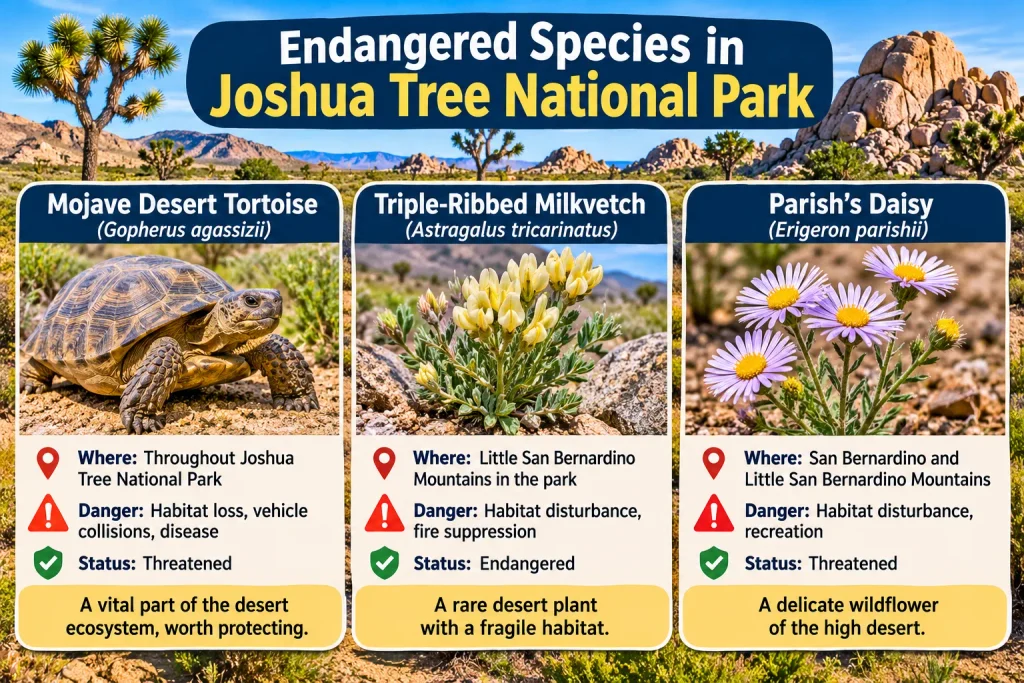
Table of Contents
Mojave Desert Tortoise (Gopherus agassizii)
The Mojave desert tortoise is one of the most important threatened wildlife species in Joshua Tree National Park. Found throughout much of the park, this slow-moving reptile is adapted to the harsh conditions of the Mojave and Sonoran deserts. It spends approximately 95% of its life underground in burrows, emerging mainly to search for food, water, and mates. Its diet includes grasses, wildflowers, cactus pads, and wild fruits, while its burrows provide protection from extreme desert temperatures and predators.
The Mojave desert tortoise is listed as threatened under the federal Endangered Species Act. In California, it was added to the endangered species list under the California Endangered Species Act on July 15, 2025. Its population has declined because of several pressures, including habitat destruction and fragmentation, vehicle collisions, off-road vehicle activity, disease, and illegal collection. Predation also affects young tortoises, particularly from ravens, whose populations have benefited from human-related food sources and infrastructure.
Conservation efforts in Joshua Tree National Park focus on protecting tortoise habitat and reducing human-related threats. The park uses measures such as tortoise fencing around construction areas, biological monitoring, and raven-resistant trash containers to reduce risks to wildlife. Visitors can also help by staying on designated roads and trails, securing their food and garbage, and never touching or removing a wild tortoise. Protecting this species is essential to preserving the Mojave Desert’s native wildlife and ecological balance.
Triple-Ribbed Milkvetch (Astragalus tricarinatus)
Triple-ribbed milkvetch is a rare flowering plant and the only federally endangered plant species identified by Joshua Tree National Park’s rare plants program. Native to Southern California, this perennial herb grows in the transition zone between the Mojave and Sonoran deserts. Within the park, it occurs mainly in the Little San Bernardino Mountains, where it grows on steep, rocky slopes and gravelly soils formed from decomposing granite. Its pale-yellow flowers generally bloom from February through May.
The species was federally listed as endangered in 1998 because of its restricted distribution, small population, and vulnerability to ground disturbance. At the time of listing, fewer than 100 individual plants had been documented. A 2015 National Park Service conservation assessment estimated approximately 3,100 individuals across 45 known occurrences at that time. More recent information on the park’s rare plants page identifies 19 occurrences within Joshua Tree National Park, most containing six or fewer individuals.
Habitat disturbance remains an important threat to triple-ribbed milkvetch in Joshua Tree National Park. Activities that physically damage plants or disturb their growing sites can affect these small and scattered populations. Fire suppression activities are also identified as a concern by the National Park Service. Protecting its limited habitat, monitoring known populations, and preventing unnecessary disturbance are essential to the long-term survival of this endangered desert plant.
Parish’s Daisy (Erigeron parishii)
Parish’s daisy is a rare flowering plant native to Southern California and one of the federally protected species found in Joshua Tree National Park. It is a low-growing perennial herb that typically reaches about 4–14 inches in height. Its narrow leaves have a grayish appearance because they are covered with fine, silvery hairs. The plant produces delicate flowers with pale pink to lavender petals surrounding a yellow center. In Joshua Tree National Park, it generally blooms from April through early June.
Parish’s daisy was listed as threatened under the federal Endangered Species Act in 1994 because of its limited distribution and the threats affecting its habitat. It grows mainly in the San Bernardino and Little San Bernardino Mountains, including areas within Joshua Tree National Park. The plant is commonly associated with north-facing slopes, shallow soils, and rocky mountain terrain. According to the National Park Service, approximately 1,200 plants occupy around 208 acres of habitat within the park, with the largest known population near Quail Mountain.
Habitat disturbance is a major concern for the survival of Parish’s daisy. Outside the park, historical threats have included carbonate mining, off-highway vehicle use, grazing, and development. Within Joshua Tree National Park, fire suppression activities and recreational use, including hiking and trail-related disturbance, are identified as important concerns. Protecting its limited mountain habitat and minimizing damage to growing sites are essential to maintaining this rare plant population.