Gray wolves are considered a keystone species in Yellowstone National Park because their influence extends far beyond their role as predators. As apex predators, they help regulate elk populations and influence where and how these herbivores feed. These changes can create a ripple effect throughout the ecosystem, influencing vegetation, other wildlife, and even habitats along rivers and streams. This ecological process, known as a trophic cascade, makes wolves an important part of Yellowstone’s natural balance.
After the last known wolf pack was killed in 1926, gray wolves were reintroduced in 1995, restoring a major predator to the ecosystem after nearly seven decades. Their return has contributed to changes in elk populations, provided food for scavengers such as grizzly bears and bald eagles, and influenced the recovery of some plant communities. The effects are complex, however, and other factors such as climate, hunting, and the presence of other predators also shape Yellowstone’s ecosystem. Understanding why wolves are a keystone species helps explain their importance to the park’s biodiversity and ecological health.
Table of Contents
Wolves as a Keystone Species in Yellowstone
Gray wolves play an important ecological role in Yellowstone National Park because their influence extends across multiple levels of the food web. A keystone species is one whose impact on an ecosystem is disproportionately large compared with its population size. Removing or reintroducing such a species can cause changes that reach far beyond its direct interactions with other wildlife.
As apex predators, wolves help regulate populations of large herbivores, particularly elk, through predation. Their presence can also influence where elk feed, how long they remain in particular areas, and how much vegetation they consume. These changes can affect the growth of willows, aspens, and other plants, which provide food and habitat for numerous animals. This indirect influence on plants and other wildlife is known as a trophic cascade.
Wolves also contribute to Yellowstone’s food web by providing carcasses that support scavengers, including ravens, bald eagles, coyotes, and bears. Their interactions with prey, competing predators, and scavengers help connect different parts of the ecosystem. Although wolves do not control every ecological process in the park, their presence helps maintain important predator-prey relationships and contributes to Yellowstone’s biodiversity.
Wolf Predation, Elk Populations, and Grazing Behavior
Elk are one of the most important prey species for gray wolves in Yellowstone National Park. By hunting elk, wolves help influence their population size and distribution, maintaining an important predator-prey relationship within the ecosystem. Wolf predation can reduce elk numbers, particularly when combined with other factors such as hunting, severe winters, drought, and changing habitat conditions.
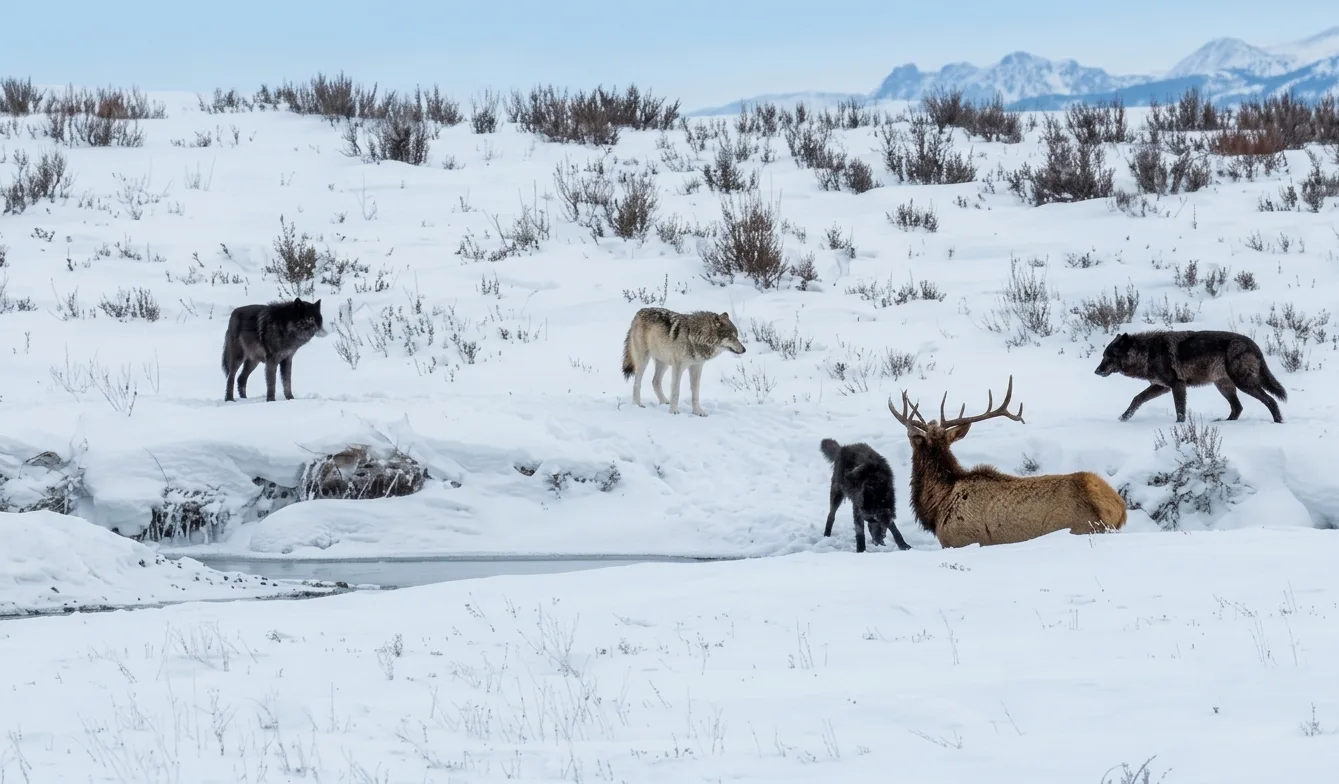
Wolves also influence elk behavior. When predators are present, elk may become more cautious and avoid spending too much time in exposed or frequently visited areas. They may move more often between feeding grounds and become less predictable in their grazing patterns. This can reduce browsing pressure on certain plants, particularly young willows, aspens, and cottonwoods growing along rivers and streams.
The return of wolves in 1995 helped restore this natural predator-prey relationship after decades without resident wolf packs in the park. However, wolf predation is only one factor affecting Yellowstone’s elk population. Human hunting outside the park, mountain lions, bears, weather conditions, and food availability also influence elk numbers and behavior.
Recovery of Willows, Aspens, and Cottonwoods
The return of gray wolves to Yellowstone National Park in 1995 helped reduce pressure from elk on some of the park’s woody vegetation. Before wolf reintroduction, large elk populations heavily browsed young willows, aspens, and cottonwoods, particularly along rivers and streams. Repeated browsing prevented many young plants from growing tall enough to develop into mature trees and shrubs.
As wolves began preying on elk and influencing their feeding patterns, browsing pressure declined in some areas. This gave certain plant communities a better opportunity to grow. Studies conducted on Yellowstone’s northern range documented increased growth and recruitment of young willows, aspens, and cottonwoods in several locations. For example, a 2012 study found that browsing on young aspen shoots in surveyed stands along the Lamar River and nearby streams had declined considerably between 1998 and 2010.
The recovery has not been uniform throughout the park. Some areas have experienced substantial vegetation growth, while others continue to face heavy browsing. Changes in water availability, stream conditions, climate, bison grazing, and elk population levels also influence plant growth. Therefore, wolf reintroduction is considered an important contributor to vegetation recovery, rather than the only cause of these changes.
The Return of Beavers and Wetland Restoration
The recovery of willows and aspens in some parts of Yellowstone has contributed to better conditions for beavers. These plants provide both food and building materials, including branches used to construct dams and lodges. As woody vegetation becomes taller and more abundant along streams, it can create more suitable habitat for beavers.
Beaver dams slow the movement of water, create ponds, and help maintain wetlands. These wetlands provide habitat for fish, amphibians, insects, waterfowl, and other wildlife. They also help retain water across the landscape, supporting aquatic and riparian habitats.
However, the relationship between wolves and beaver recovery is not direct or exclusive. Although reduced elk browsing following wolf reintroduction may have helped some willow and aspen communities recover, beaver populations are also influenced by water availability, stream conditions, climate, and other environmental factors. Yellowstone recorded an estimated 121 beaver colonies in 2024, compared with 49 in 1996 and 127 in 2007. These figures show changes in the number of recorded colonies, but they do not establish that wolf reintroduction alone caused the increase.
Effects on Riverbanks and Aquatic Ecosystems
The influence of gray wolves in Yellowstone National Park can extend beyond terrestrial vegetation to the streams and rivers that flow through the park. As wolf predation and other ecological factors reduce elk browsing pressure in some areas, willows and other woody plants have a better opportunity to grow along streambanks. Their roots help hold soil together, while their branches and leaves provide shade and cover for aquatic habitats.
Healthy riparian vegetation can slow water movement near streambanks, reduce soil erosion, and help trap sediment during high-water flows. Over time, these processes can support more stable stream channels and create better conditions for floodplains to develop. Vegetation growing over streams also provides shade, which can help regulate water temperatures and maintain suitable conditions for aquatic organisms, including fish and aquatic insects.
Research conducted along Blacktail Deer Creek in Yellowstone’s northern range documented encouraging changes between 2004 and 2017. Willow plants grew substantially taller, streamside canopy cover increased, and researchers observed signs of improving streambank vegetation and floodplain development. These findings were consistent with a trophic cascade involving wolves and other large carnivores, reduced elk browsing, and vegetation recovery.
However, the recovery of rivers and streams is not controlled by wolves alone. Water availability, stream flow, beaver activity, climate, and the physical condition of stream channels also influence aquatic ecosystems. A Yellowstone study published in 2013 found that reducing elk browsing alone was not enough to restore some riparian areas; suitable hydrological conditions were also necessary. This shows how predator recovery can contribute to healthier waterways through several interconnected ecological processes.
Wolves and the Balance of Other Predator Populations
Gray wolves influence other predators in Yellowstone National Park through competition for food, territorial interactions, and direct attacks. One of the clearest examples involves coyotes, which compete with wolves for prey and carrion. Before wolves returned in 1995, coyotes faced less competition and predation from large canids in Yellowstone, particularly across the northern range.
Following wolf reintroduction, coyote numbers declined in areas occupied by wolf packs. Wolves killed coyotes, especially those approaching wolf-killed carcasses, and also competed with them for food and territory. A long-term ecological study found that coyote densities in Yellowstone declined by approximately 39% following wolf reintroduction. More recent National Park Service observations indicate that coyote numbers have increased again in parts of the park, including the Lamar Valley.
Changes in coyote populations can influence smaller predators and other wildlife. With fewer coyotes in some areas, smaller carnivores such as red foxes may experience reduced competition for rodents and other small prey. Coyotes also prey on small mammals and occasionally young pronghorn, so changes in their abundance can affect these prey species. However, the extent of these indirect effects varies, and researchers have not established that wolf recovery alone caused increases in red foxes or pronghorn survival.
These interactions demonstrate that wolves help shape Yellowstone’s predator community, not simply by hunting elk but also by influencing the abundance, behavior, and distribution of other carnivores.
Food Sources for Scavengers
Gray wolves support Yellowstone’s scavenger community by leaving behind carcasses and remains from their kills. Although wolves consume much of their prey, they do not always eat an entire elk or other large animal. The leftover meat, bones, and internal organs provide an important food source for wildlife that depends on carrion, particularly during winter and early spring when other food sources may be scarce.
Ravens are among the most frequent scavengers around wolf kills. They often locate carcasses quickly and feed on leftover meat, sometimes following wolf packs to find feeding opportunities. Bald eagles, golden eagles, magpies, and other birds also benefit from these remains. Mammalian scavengers, including coyotes and grizzly bears, use wolf-killed carcasses as an additional source of food.
This food supply can be particularly valuable to grizzly bears emerging from winter hibernation. In early spring, when berries and other plant foods are not yet widely available, elk carcasses provide protein and calories that help bears regain energy. Bears may even displace wolves from their kills because of their size and strength, although wolves sometimes defend carcasses or return to feed after a bear leaves.
By making food available to several other species, wolves strengthen connections within Yellowstone’s food web. Their kills support a wide range of scavengers and help transfer energy from large herbivores to animals that do not necessarily hunt large prey themselves.
The Relationship Between Wolves and Grizzly Bears
Gray wolves and grizzly bears share the Yellowstone ecosystem and have a complex relationship involving competition, scavenging, and occasional conflict. Both species feed on elk and other large mammals, which means they sometimes compete for the same food resources. However, their interactions are not always hostile, and wolf activity can also provide important feeding opportunities for grizzly bears.
One of the most significant interactions occurs around wolf-killed carcasses. Grizzly bears frequently approach these kills and may take control of them using their greater size and strength. Wolves often retreat when a bear arrives, although they may remain nearby and return to the carcass later. This behavior, known as kleptoparasitism, occurs when one animal takes food that another animal has obtained.
Wolf kills are particularly valuable to grizzly bears in spring, when they emerge from hibernation and need to replenish their energy reserves. At this time, plant foods such as berries are not yet widely available, making animal carcasses an important source of calories and protein. Wolves therefore provide an additional food source that can benefit bears during a demanding period of the year.
The History of Wolf Reintroduction in Yellowstone
Gray wolves once roamed throughout Yellowstone National Park, but decades of government-sponsored predator control programs and hunting led to the disappearance of resident wolf packs from the park. During the late 1800s and early 1900s, wolves were widely killed because they were considered threats to livestock and other wildlife. By 1926, the last known wolf pack in Yellowstone had been killed through predator-control programs, although occasional single wolves were reported afterward. The absence of resident wolf packs continued for nearly seven decades, leaving the park without an established population of its native apex predators.
The recovery of gray wolves became a conservation priority after the passage of the Endangered Species Act in 1973. In 1987, the U.S. Fish and Wildlife Service proposed reintroducing wolves into Yellowstone and central Idaho as part of its Northern Rocky Mountain Wolf Recovery Plan. Congress funded environmental studies in 1991, and after extensive public consultation, the federal government approved the reintroduction plan in June 1994. The proposal faced opposition, particularly from some local ranchers concerned about livestock losses.
In January 1995, wildlife officials captured 14 gray wolves in Alberta, Canada, and transported them to Yellowstone. The wolves were placed in temporary acclimation pens to help them adjust to their new surroundings before being released into the wild. The first group included wolves from several social groups that eventually formed the Crystal Creek, Rose Creek, and Soda Butte packs. The gates of the pens were opened in March 1995, allowing the wolves to establish territories in the park.
The reintroduction continued in January 1996, when another 17 wolves from British Columbia, Canada, arrived in Yellowstone. After a period of acclimation, they were released in April. In late 1996, 10 orphaned wolf pups from the Sawtooth Pack in northwestern Montana were brought to Yellowstone after their parents were killed following livestock depredations. The pups were placed in an acclimation pen with two wolves from the Nez Perce group in an effort to help them form a cohesive pack. They were released in 1997. In total, 41 wolves were released in Yellowstone between 1995 and 1997. Their population grew through natural reproduction and the establishment of new packs, making the project an important milestone in American wildlife conservation.
The return of wolves restored a native predator to Yellowstone and created new opportunities for scientists to study predator-prey relationships and ecosystem changes. The reintroduction also became one of the most significant wildlife restoration projects in the United States, demonstrating how conservation planning can help recover a species that had been eliminated from its natural habitat.
Wolves and Yellowstone’s Overall Biodiversity
Gray wolves contribute to Yellowstone National Park’s biodiversity by influencing relationships among predators, herbivores, plants, and scavengers. As apex predators, they help regulate prey populations and affect how other animals use the landscape. These interactions influence several parts of the food web, making wolves an important species in maintaining ecological balance.
Their presence benefits wildlife beyond their direct prey. Wolf-killed carcasses provide food for scavengers such as ravens, bald eagles, coyotes, and grizzly bears. Their competition with coyotes can also influence the distribution of smaller carnivores and their prey. Meanwhile, changes in elk browsing patterns can create opportunities for willows, aspens, and other vegetation to grow in certain areas, supporting habitats used by beavers, birds, and aquatic wildlife.
Wolves also contribute to the ecological processes that connect Yellowstone’s forests, grasslands, rivers, and wetlands. By influencing the movement and feeding behavior of large herbivores, they can affect vegetation growth and the availability of food and shelter for other species. These effects vary across the park and depend on factors such as climate, water availability, other predators, and human activities.
The return of wolves in 1995 restored an important native predator to Yellowstone after nearly 70 years of absence. Their ecological influence demonstrates why keystone species matter: the presence of one animal can affect numerous other organisms and ecological relationships. Although wolves are not solely responsible for Yellowstone’s biodiversity, they remain an essential part of the park’s complex ecosystem.