Zion National Park is famous for its towering red cliffs, narrow canyons, and spectacular desert landscapes. But some of the wildlife living among these sandstone formations deserves just as much attention as the scenery. One animal that may surprise visitors is the rock squirrel, which can cause trouble when people feed it or get too close.
From food-stealing squirrels and venomous snakes to black bears, mountain lions, and painful stinging insects, Zion is home to several animals that can pose risks to unsuspecting visitors. Some encounters are uncommon but potentially serious, while others happen because hikers get too close or leave food unattended.
Knowing which animals to watch for, where you might encounter them, and how to respond can help you avoid trouble and enjoy your visit safely. Here are the dangerous animals in Zion National Park that every visitor should know about.
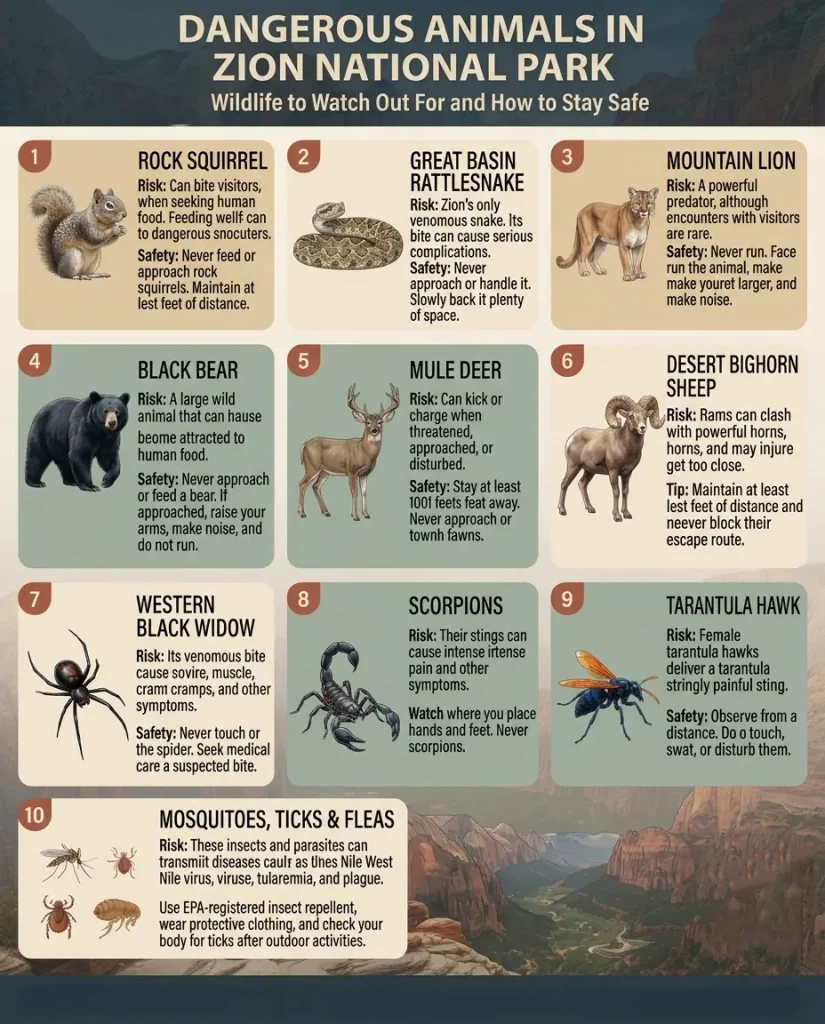
Table of Contents
Rock Squirrels
Rock squirrels may look harmless, but they can bite when approached or when visitors try to feed or touch them. These large ground squirrels are particularly bold around picnic areas, trails, and other places where hikers stop to eat.
Typically measuring 17 to 21 inches (43 to 53 cm) long, rock squirrels have grayish-brown fur, sometimes with cinnamon-colored patches. They are excellent climbers and often sit on boulders and cliffs, where they watch for predators and other dangers. One common place to spot them is along the Riverside Walk.
The problem begins when visitors feed them. Rock squirrels quickly learn to associate people with food and may approach hikers, raid backpacks and lunch bags, or even snatch food directly from someone’s hand. When people try to feed, touch, or chase them away, the squirrels may bite. Their sharp teeth can cause serious wounds, and bites or scratches from wild rodents can expose people to infections.
Feeding them also harms the animals. Human food is difficult for rock squirrels to digest, and Zion National Park reports that feeding has contributed to several squirrel deaths.
To avoid an unpleasant encounter, never feed or touch a rock squirrel, and keep at least 50 feet (15 m) away. Store snacks securely, keep backpacks and lunch bags closed, and never leave food unattended. If a squirrel approaches, move away rather than trying to handle or scare it off. If you are bitten or scratched, wash the wound thoroughly and seek medical advice.
Great Basin Rattlesnakes
Zion National Park is home to 13 snake species, but only one is venomous: the Great Basin rattlesnake (Crotalus oreganus lutosus). Although bites are uncommon, an encounter can become dangerous if a hiker accidentally steps near one or tries to handle it.
The Great Basin rattlesnake is usually light brown or tan, with darker brown blotches running along its back. It has a broad, triangular head and a distinctive rattle at the end of its tail. However, the rattle is not always present. Young snakes may not have developed one yet, and older snakes can lose sections of their rattles.
These snakes prefer dry, rocky areas with moderate vegetation, where they can find shelter and prey such as mice, rats, rabbits, and other small animals. They are more active during warm weather, but may become nocturnal during the hottest summer periods, hiding in shaded places or underground during the day.
Rattlesnakes generally avoid people and usually bite only when threatened, startled, or accidentally disturbed. To reduce your chances of an encounter, stay on marked trails and watch where you step, sit, or place your hands. Before climbing over rocks or stepping across a fallen log, check the area carefully. Never attempt to touch, move, or kill a snake.
If you hear a rattling sound, stop and identify where it is coming from without approaching. Slowly back away and give the snake plenty of space. If someone is bitten, call 911 immediately, keep the person calm and still, and remove rings or other tight items near the bite before swelling begins. Do not apply ice or a tourniquet, cut the wound, or attempt to suck out the venom. Get emergency medical attention even if symptoms initially seem mild.
Mountain Lions
Mountain lions are among the most powerful predators in Zion National Park, but spotting one is extremely rare. These elusive cats roam from the park’s deep canyons to its high plateaus, usually avoiding crowded areas such as the main canyon.
Also known as cougars or pumas, mountain lions are large, solitary animals that can measure 6 to 9 feet (1.8 to 2.7 m) from nose to tail and weigh between 80 and 180 pounds (36 to 82 kg). They have excellent night vision and are most active from dusk until dawn, when they hunt animals such as mule deer and desert bighorn sheep.
The total mountain lion population in Zion National Park is unknown, but the National Park Service estimates that the park may be home to as few as half a dozen. Sightings have been reported in the Kolob Canyons area, and motion-activated cameras have captured them in the park’s backcountry. Although encounters are possible, the park has never recorded an attack on a person or pet.
If you are hiking in mountain lion habitat, keep children close, avoid hiking alone when possible, and be especially alert around dawn and dusk. Never approach a mountain lion or move closer to a carcass, as the animal may return to its kill.
If you encounter one, do not run. Running can trigger its instinct to chase. Instead, face the animal, raise your arms to appear larger, make loud noises, and give it room to escape. If it approaches, wave your arms and throw rocks or sticks in its direction. If it attacks, fight back rather than playing dead. Report sightings to a park ranger.
Black Bears
Black bears are not the first animals most visitors expect to encounter in Zion National Park, but they are part of the park’s wildlife. Although sightings are relatively uncommon, visitors should know how to respond if they encounter one, particularly when hiking or camping in less-visited areas.
Black bear sightings have been reported in the park’s northern and higher country, including Kolob Terrace Road, the Lava Point area, and Lava Point Campground, which sits at nearly 8,000 feet (2,438 m). Bear warning signs have also been placed near the Hop Valley trailhead. These cooler, forested areas provide suitable habitat for bears compared with the hotter, drier landscapes of Zion’s main canyon.
Black bears are powerful animals with strong claws, teeth, and an excellent sense of smell. Adult black bears typically measure 5–6 feet (1.5–1.8 m) in length and stand about 2–3 feet (0.6–0.9 m) at the shoulder. Adult males generally weigh 100–300 pounds (45–136 kg), while females typically weigh 100–175 pounds (45–79 kg). They are generally shy and tend to avoid people, but they can become dangerous if surprised, approached, or attracted to food at campsites. Improperly stored food, garbage, toiletries, and other scented items can draw bears into visitor areas and increase the risk of encounters.
To reduce this risk, store all food, drinks, trash, and scented products in bear-resistant containers or designated food-storage lockers. Never leave food inside an unattended backpack or tent. If you see a bear, do not approach it or run away. Raise your arms to appear larger, wave them, and make loud noises. If the bear approaches, throw rocks or sticks in its direction while giving it room to escape. If attacked, fight back rather than playing dead.
Black bear encounters in Zion remain unusual, and the National Park Service reports no attacks on people or pets in the park. Nevertheless, visitors exploring the higher country should take food-storage rules seriously and give every bear plenty of space.
Mule Deer
Mule deer are among the most commonly seen large mammals in Zion National Park. Visitors often spot them grazing near campgrounds, Zion Lodge, and along the Virgin River in Zion Canyon. Their calm appearance can make them seem harmless, but these wild animals can cause serious injuries if approached too closely.
Adult mule deer measure approximately 3.9–6.9 feet (1.2–2.1 m) in length from nose to tail and stand about 3–3.5 feet (0.9–1.1 m) tall at the shoulder. Adult males, known as bucks, typically weigh 125–250 pounds (57–113 kg), while females, known as does, weigh around 100–150 pounds (45–68 kg).
Mule deer are named for their large, mule-like ears, which help them release body heat in the desert environment. Adult males, known as bucks, grow antlers that they use to compete with other males during the fall breeding season, or rut. During this period, deer may become more unpredictable, particularly when competing for mates.
Although mule deer generally avoid people, they can suddenly buck or kick when frightened or approached. Their sharp hooves can cause significant injuries. Visitors should stay at least 100 feet (30 m) away and never attempt to feed, touch, or approach them.
Young fawns are another reason to keep your distance. A fawn resting alone in grass or beneath a tree has not necessarily been abandoned. Mother deer often leave their young hidden while they feed nearby. Never touch, move, or approach a fawn.
Mule deer also pose a danger on park roads. They frequently move through areas crossed by vehicles, and collisions can injure both animals and motorists. Zion’s maximum speed limit is 35 mph (56 km/h) unless otherwise posted. Drive carefully, especially around dawn and dusk, when deer are more active, and watch for animals crossing the road.
Desert Bighorn Sheep
Desert bighorn sheep are one of the most recognizable wild animals in Zion National Park, particularly along its eastern side. Although they usually avoid people, their size, powerful horns, and unpredictable movements can create safety risks, especially when they cross roads or when males compete during the breeding season.
Adult desert bighorn sheep measure approximately 5 feet (1.5 m) in length and stand 2.5–3.25 feet (0.76–0.99 m) tall at the shoulder. Adult males, known as rams, typically weigh 120–220 pounds (54–100 kg), while females, known as ewes, weigh around 100–155 pounds (45–70 kg). Rams are generally larger and have much heavier, more curved horns than females.
Desert bighorn sheep once disappeared from Zion National Park due to hunting, habitat loss, and disease. To restore the species, the National Park Service and Utah wildlife officials returned 14 sheep to the Zion wilderness by 1978. The reintroduction program helped reestablish a population of these native animals in the park.
Visitors have the best chance of spotting them between the Zion-Mount Carmel Tunnel and the East Entrance. They are skilled climbers and often move across steep sandstone cliffs, rocky slopes, and narrow ledges. However, they may also walk directly across the highway, creating a collision risk for both the animals and motorists. Blind curves along the eastern road make sudden crossings particularly dangerous.
Male bighorn sheep, known as rams, can also become more aggressive toward one another during the mating season, called the rut, which runs from July through October. Rams compete for access to females by charging and crashing their large horns together. Visitors should never approach fighting animals or try to get between them.
When driving through the park’s eastern section, slow down and watch for sheep crossing the road. Use designated roadside pullouts to observe or photograph them rather than stopping in the roadway. Stay at least 100 feet (30 m) away, never feed them, and avoid approaching them on rocky slopes. Giving these animals room to move is the safest way to enjoy one of Zion’s most memorable wildlife encounters.
Western Black Widows
The western black widow is one of the venomous spiders visitors may encounter in Zion National Park. Although small and usually hidden from view, its bite can cause significant pain and other symptoms that may require medical attention.
Female western black widows are shiny black spiders with a distinctive red hourglass marking on the underside of their rounded abdomen. They are less than 0.8 inches (2 cm) long. Males are smaller, slimmer, and usually brown with cream-colored markings.
According to the National Park Service, black widows are widespread throughout Zion and are often found in or around buildings. They build irregular webs in sheltered places and typically hang upside down while waiting for insects to become trapped. Sheds, storage areas, and other quiet spaces can provide suitable hiding places.
Black widows generally avoid people, but a female may bite if disturbed, trapped, or accidentally pressed against the skin. A bite can cause pain, sweating, muscle cramps, and increased blood pressure. The severity of symptoms varies, so a suspected black widow bite should not be ignored.
Visitors can reduce the risk by checking dark, undisturbed areas before reaching into them. Shake out shoes, gloves, clothing, and camping gear that have been left outside, and avoid putting your hands into crevices or beneath rocks without looking first. If bitten, seek medical attention promptly.
Scorpions
Scorpions are among the desert creatures visitors should watch for in Zion National Park, particularly after sunset. The park is home to the giant desert hairy scorpion, a large species that hides during the day and comes out at night to hunt. Although its sting is usually more painful than dangerous, disturbing one can lead to an unpleasant encounter.
The giant desert hairy scorpion (Hadrurus arizonensis) has a dark gray body and tan-to-golden legs. It can grow to approximately 4.7 inches (12 cm) in length, excluding its tail. It typically lives in burrows in desert washes and low-elevation valleys, where it hunts large insects and occasionally small reptiles and other animals.
One interesting feature is that its body fluoresces under ultraviolet (UV) light. Visitors walking through the desert at night may spot scorpions glowing under a UV flashlight. However, never approach, touch, or attempt to pick one up. The National Park Service warns that the giant desert hairy scorpion can sting when disturbed.
Another species worth knowing about is the Arizona bark scorpion. Utah Poison Control lists this scorpion in Kane County, which includes part of the Zion region, although its presence throughout the national park is not established. Its sting can cause more serious symptoms than those of most Utah scorpions, including abnormal muscle movements and, in severe cases, breathing difficulties. Children are particularly vulnerable.
To avoid stings, wear shoes after dark, use a flashlight around campsites, and shake out boots, clothing, gloves, and sleeping bags before using them. Never put your hands into rock crevices or beneath objects without checking first. If stung, contact the Utah Poison Control Center at 1-800-222-1222 for medical advice. Seek emergency care if severe pain, abnormal muscle movements, or breathing difficulties develop.
Tarantula Hawks
Tarantula hawks are large wasps found throughout Zion National Park, and their sting is considered extremely painful. Although they do not usually bother people, visitors should avoid touching, catching, or swatting these insects.
The tarantula hawk (Pepsis formosa) has a slender black or metallic blue body, long legs, and bright orange wings. It measures approximately 1.2 to 2 inches (3 to 5 cm) long. Despite its name, it is not a bird but a type of wasp.
Female tarantula hawks hunt tarantulas. They sting and paralyze a spider, drag it into a burrow, and lay an egg on it. When the egg hatches, the larva feeds on the paralyzed spider. Adult wasps feed mainly on nectar, particularly from whorled milkweed. The National Park Service also notes that fermented nectar can make these wasps fly erratically.
For visitors, the main concern is their painful sting. Tarantula hawks are generally not aggressive toward people, but they may sting if grabbed, stepped on, or otherwise threatened. Watch where you walk, avoid handling them, and give them space when they are feeding on flowers.
If stung, wash the affected area with soap and water and apply a cold pack to help reduce pain and swelling. Seek emergency medical help if you experience difficulty breathing, dizziness, or swelling of the face or throat, as these may indicate a serious allergic reaction.
Mosquitoes, Ticks, and Fleas
Mosquitoes, ticks, and fleas may be much smaller than Zion’s other dangerous animals, but their bites can expose visitors to disease-causing organisms. Mosquitoes can transmit West Nile virus, certain ticks can spread Lyme disease and tularemia, and infected fleas can transmit bubonic plague. Tularemia can also spread through the bites of infected deer flies.
Mosquito activity is generally higher during warmer months, when these insects are most active. Different mosquito species breed in different water habitats, including stagnant water, marshes, and temporary pools. Their bites can cause itching and irritation.
Ticks can attach themselves to skin or clothing while visitors walk through vegetation and brush. Some ticks carry bacteria that cause Lyme disease and other infections. Fleas are another concern because they can live on wild rodents and other mammals and may carry the bacteria responsible for plague.
To reduce the risk of bites, use an EPA-registered insect repellent, wear long sleeves and long pants when hiking through brush, and check your skin, clothing, and gear for ticks after spending time outdoors. Avoid touching wild rodents or other animals, including those that appear sick or dead.
If you develop a fever, rash, unusual swelling, or flu-like symptoms after an insect or tick bite, seek medical advice and mention your recent visit to Zion. Not every bite transmits disease, but taking precautions can help prevent avoidable health problems during your trip.