Joshua Tree National Park in Southern California is known for its distinctive desert landscapes, unusual rock formations, and iconic Joshua trees. However, the park’s natural environment is more diverse than its name might suggest. Differences in elevation and climate create a variety of habitats, supporting an interesting mix of desert vegetation and wildlife.
From spiny cacti and drought-resistant shrubs to mountain trees and specially adapted desert animals, the park offers a closer look at how life survives in challenging environments. Its ecological diversity makes Joshua Tree an interesting place to understand the characteristics of the desert biome.
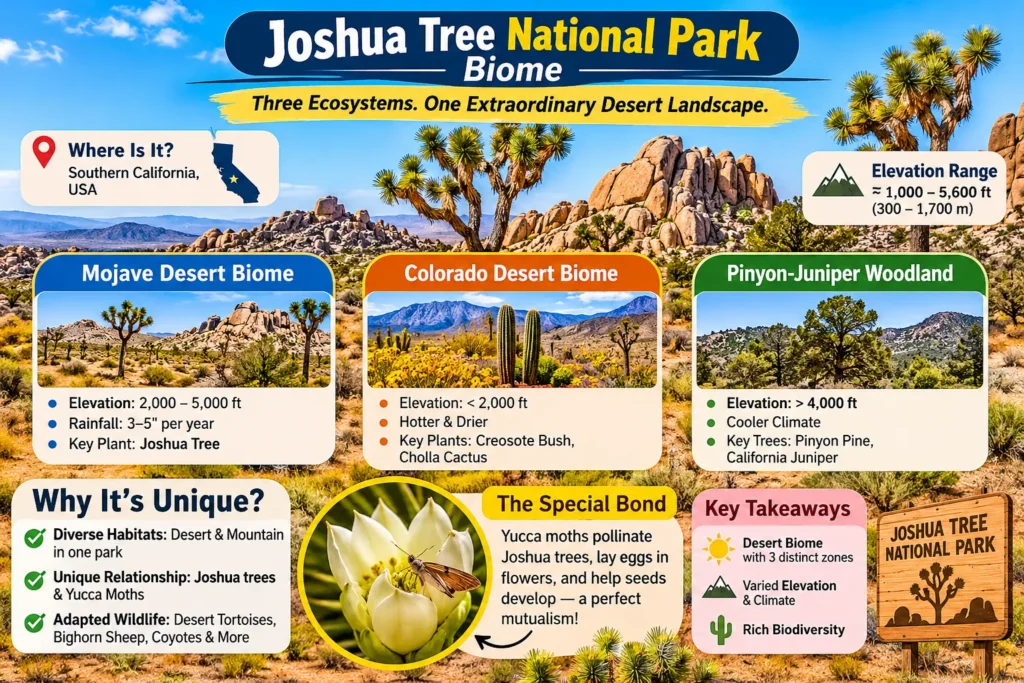
Table of Contents
What Biome Is Joshua Tree National Park In?
Joshua Tree National Park is part of the desert biome, but it contains three distinct ecological zones. The two major desert ecosystems are the Mojave Desert, which occupies the northern and western portions of the park, and the Colorado Desert, which covers much of the southern and eastern areas. The Colorado Desert is the western extension of the larger Sonoran Desert.
A third ecosystem occurs at higher elevations in the westernmost part of the park, where the Little San Bernardino Mountains support pinyon pine and California juniper woodlands. These three environments differ in elevation, temperature, precipitation, and vegetation. Together, they create a varied landscape that ranges from Joshua tree-covered high desert to hotter, cactus-rich lowlands and mountain woodlands.
Mojave Desert Biome
The Mojave Desert occupies the western and higher-elevation portions of Joshua Tree National Park, extending across elevations of approximately 2,000 to 5,000 feet. This higher desert environment is generally cooler than the Colorado Desert and receives approximately 3 to 5 inches of precipitation annually, most of it during the winter months.
The most recognizable feature of this biome is the Joshua tree (Yucca brevifolia), which is native to the Mojave Desert and serves as an indicator species of this ecosystem. These distinctive plants grow across open desert plains, rocky hills, and broad valleys, creating the characteristic landscapes associated with Joshua Tree National Park. Their stiff, sharply pointed leaves and drought-adapted structure help them survive in the dry environment. Joshua trees can live for around 150 years on average, although some individuals survive for more than 300 years.
Along with Joshua trees, the Mojave Desert supports a variety of drought-tolerant plants, including Mojave yucca, blackbrush, creosote bush, Mojave prickly pear, and Parry’s nolina. These species have different adaptations for surviving limited rainfall. For example, blackbrush can shed its leaves during hot, dry periods to reduce moisture loss, while cacti have spines instead of conventional leaves. In years with sufficient winter rainfall, the desert floor may also produce seasonal wildflowers and grasses. These plants can remain dormant as seeds during dry periods and bloom for a short time when conditions become favorable.
Joshua trees also play an important role in supporting wildlife. Their branches and spiky leaves provide shelter and nesting sites for birds such as Scott’s oriole, ladder-backed woodpecker, and western scrub jay. The loggerhead shrike uses the tree’s sharp leaves to impale prey, while woodrats and other small animals find shelter among fallen leaves and branches. Other wildlife in this part of the park includes desert bighorn sheep, coyotes, black-tailed jackrabbits, and various reptiles and rodents.
Although the Mojave is a desert, its higher elevation gives it a different climate from the hotter lowlands. Winter nights can become cold, and temperatures may occasionally fall below freezing. Limited rainfall, dry conditions, and substantial temperature changes shape the vegetation and wildlife found throughout this part of the park.
Colorado Desert Biome
The Colorado Desert occupies the eastern and southern portions of Joshua Tree National Park and represents the westernmost extension of the Sonoran Desert. It is generally found at lower elevations than the Mojave Desert, with many areas lying below 2,000 feet. This region has hotter temperatures, less rainfall, and wide-open desert basins separated by mountain ranges. Unlike the cooler Mojave region, Joshua trees do not grow naturally in this part of the park.
The vegetation is adapted to intense heat and limited water. Creosote bush is one of the most widespread shrubs, while ocotillo, palo verde, desert ironwood, smoketree, and several varieties of cholla cactus are also found here. Near the boundary between the Mojave and Colorado deserts, the Cholla Cactus Garden is particularly known for its dense clusters of teddy bear cholla. Its loosely attached spines can detach easily and cling to passing animals or people, earning it the nickname “jumping cholla.” Nearby, the Ocotillo Patch features tall, thorny branches that produce green leaves after rainfall and bright red flowers, particularly during spring.
Following favorable winter rainfall, wildflowers such as chuparosa and desert sand verbena add seasonal color to the otherwise dry landscape. These plants take advantage of brief periods of favorable moisture to grow, flower, and produce seeds.
Although parts of the Colorado Desert may appear barren, this ecosystem supports a greater diversity of plants and animals than the Mojave Desert. Kangaroo rats, for example, are remarkably adapted to water scarcity and can survive without drinking water, obtaining much of their moisture from the food they eat. Desert woodrats also build nests among teddy bear cholla plants, using their spines as protection from predators. These specialized adaptations allow plants and animals to survive in the Colorado Desert despite extreme heat and limited water availability.
The Pinyon-Juniper Woodland Transition Zone
In the westernmost part of Joshua Tree National Park, above approximately 4,000 feet, the landscape changes from open desert vegetation to a higher-elevation woodland community. Located in the Little San Bernardino Mountains, this zone forms the park’s third major ecological environment. Its cooler conditions support trees such as pinyon pine and California juniper, along with shrubs and other mountain vegetation.
The woodland is characterized by singleleaf pinyon pine (Pinus monophylla) and California juniper (Juniperus californica). These trees grow in relatively open stands rather than forming a dense forest. They are accompanied by shrubs such as Muller’s oak (Quercus cornelius-mulleri), along with native grasses and other low-growing plants. Together, these vegetation layers create a varied habitat across the rocky slopes, mountain valleys, and higher-elevation terrain.
This ecosystem also provides important resources for wildlife. Pinyon pines and junipers offer food and shelter, while shrubs and grasses provide additional cover and foraging opportunities. The woodland’s cooler conditions and varied vegetation make it an important habitat within the park, particularly compared with the hotter and more exposed desert lowlands.
The woodland community is especially noticeable around Black Rock Canyon and Covington Flats. These higher-elevation areas contain some of the park’s largest pinyon pines and junipers. Elevations around Covington Flats range from approximately 4,800 to 5,600 feet, and freezing temperatures are common during the colder months. Although this woodland occupies a smaller part of the park, it adds an important mountain habitat to Joshua Tree’s ecological diversity.
Why Elevation Is So Important
Elevation is one of the main factors shaping the ecosystems of Joshua Tree National Park. As the land rises from the eastern and southern lowlands toward the western mountains, temperatures generally become cooler and precipitation patterns change. These variations influence the types of plants that can grow and the wildlife that can survive in different parts of the park.
The lower Colorado Desert, mostly below 2,000 feet, experiences hotter and drier conditions. At higher elevations, the Mojave Desert provides a cooler environment where Joshua trees and other desert plants thrive. Above approximately 4,000 feet in the westernmost part of the park, conditions support pinyon pine and California juniper woodlands. These elevation-related changes create gradual transitions between different plant communities rather than sharply defined ecological boundaries.
The park’s dry climate is also influenced by the rain-shadow effect. Mountains west of Joshua Tree, including Mount San Jacinto and Mount San Gorgonio, intercept moist air moving inland from the Pacific Ocean. As this air rises over the mountains, it cools and releases much of its moisture as precipitation. By the time the air reaches the eastern side of the mountain ranges, it is considerably drier, leaving Joshua Tree National Park in a rain-shadow region.
Another important characteristic of the park’s desert climate is its wide daily temperature range. Because the air contains little moisture, the ground heats up rapidly during the day and loses heat quickly after sunset. As a result, daily high and low temperatures can differ by as much as 50°F (28°C) within the park. These temperature fluctuations, combined with differences in elevation and water availability, help explain the variety of habitats found across Joshua Tree National Park.
What Makes the Joshua Tree Biome Unique?
What makes Joshua Tree National Park particularly distinctive is the close proximity of contrasting habitats within a relatively compact landscape. Differences in elevation, temperature, and water availability allow desert plants, mountain trees, and specialized wildlife to coexist across the park. This variety of environments also supports unusual ecological relationships that are important to the survival of native species.
One of the park’s most remarkable ecological relationships is the mutualism between Joshua trees and yucca moths. Joshua trees depend on these moths for pollination. Female yucca moths lay their eggs inside a flower’s ovary and then deliberately transfer pollen to its stigma. As the seeds develop, the moth larvae hatch and feed on a portion of them. This specialized relationship benefits both species: the tree receives the pollination needed for seed production, while the developing seeds provide food for the moth’s offspring.
The park’s plants and animals also demonstrate a wide range of adaptations to desert conditions. Many plants have small or waxy leaves, spines, or extensive root systems that help them conserve or obtain water. Animals such as desert tortoises, bighorn sheep, coyotes, and kangaroo rats have different strategies for coping with heat and limited water. These adaptations allow wildlife to survive across the park’s varied habitats.
The combination of contrasting desert ecosystems, mountain woodlands, and specialized plant-animal relationships makes Joshua Tree National Park an exceptional example of desert biodiversity. Its ecological diversity shows how differences in elevation, climate, and water availability shape the plants and animals that survive in this landscape.