The food web of Zion National Park connects the plants, animals, and decomposers that sustain life across southwestern Utah’s diverse landscapes. From desert shrubs and grasses to cottonwood trees along the Virgin River, plants capture solar energy and provide food for herbivores such as mule deer, rabbits, and rodents. These animals, in turn, support predators including snakes, foxes, hawks, owls, and mountain lions.
Zion’s food web spans several habitats, including desert shrublands, pinyon-juniper woodlands, forested highlands, and river corridors. Each habitat supports different feeding relationships, while many species connect multiple parts of the ecosystem by consuming a variety of foods or serving as prey for different predators. Decomposers, including fungi and bacteria, break down dead organic matter and return nutrients to the environment, supporting continued plant growth.
Understanding the Zion National Park food web reveals how energy moves between trophic levels and how changes in one population can affect other organisms. These connections help explain why conserving native plants, wildlife, and natural habitats is essential to maintaining the ecological health of Zion National Park.
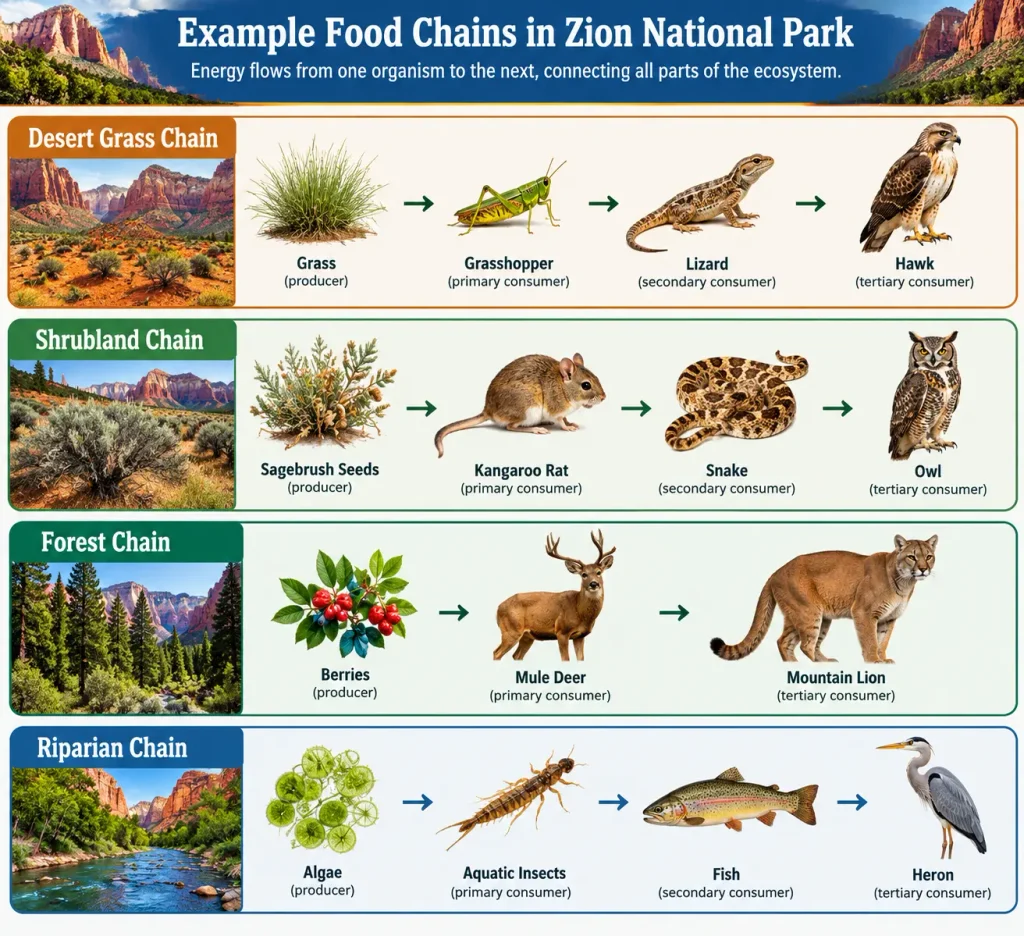
Table of Contents
Quick Reference: Zion National Park Food Web
| Trophic Level | Examples in Zion National Park | Role in the Food Web |
|---|---|---|
| Producers | Sagebrush, prickly pear cactus, yucca, native grasses, Fremont cottonwoods, willows, algae | Capture sunlight through photosynthesis and provide the primary energy source for consumers. |
| Primary Consumers | Mule deer, desert cottontails, rock squirrels, seed-eating rodents, grasshoppers, caterpillars | Feed on plants, seeds, algae, or other producers and transfer energy to higher trophic levels. |
| Secondary Consumers | Insect-eating lizards, snakes, insect-eating birds, foxes | Feed on insects, rodents, or other primary consumers; some species also eat other food types. |
| Tertiary Consumers | Hawks, owls, and other predators when they eat secondary consumers | Feed on secondary consumers in particular food chains. Their trophic position depends on the prey they eat. |
| Decomposers | Fungi, bacteria | Break down dead organisms and organic matter, returning nutrients to the environment. |
| Detritivores | Certain beetles, ants, and other detritus-feeding invertebrates | Consume dead or decaying organic material and help decomposition and nutrient cycling. |
Note: A species can occupy different trophic levels depending on what it eats. Omnivores such as coyotes may feed on both plant and animal matter, so they do not belong to just one fixed trophic level.
Producers in the Zion National Park Food Web
Producers form the foundation of the Zion National Park food web by capturing sunlight and converting it into chemical energy through photosynthesis. They include native grasses, shrubs, cacti, wildflowers, trees, and algae. These organisms supply the energy that supports herbivores and, indirectly, the predators and scavengers that feed on other animals.
In Zion’s dry, lower-elevation habitats, plants such as sagebrush, prickly pear cactus, and yucca are adapted to limited water availability and hot summers. Native grasses and seasonal wildflowers also produce leaves, stems, and seeds eaten by insects, rodents, rabbits, and other plant-feeding animals. These feeding relationships transfer energy from vegetation to the consumers that depend on it.
Along the Virgin River, Fremont cottonwoods, willows, and other riparian plants benefit from greater water availability. Their leaves, seeds, and other plant material provide food for wildlife, while their branches and foliage offer shelter and nesting habitat. At higher elevations, pinyon pines, junipers, and ponderosa pines produce seeds and other plant material that support birds, rodents, and additional consumers.
Algae and other photosynthetic organisms also contribute to aquatic food webs in Zion’s streams and river habitats. Depending on the species and conditions, algae can be consumed by aquatic invertebrates, which may then serve as prey for fish and insect-eating birds. This creates connections between aquatic producers and consumers that feed in or near the water.
The availability and distribution of producers influence how much energy enters Zion’s food web and where that energy becomes available to consumers. When plants produce leaves, seeds, and other edible material, they support herbivore populations and help sustain the predators that feed on them. Producers therefore connect sunlight and the park’s physical environment to the wildlife communities living across its different habitats.
Primary Consumers in Zion National Park
Primary consumers occupy the trophic level immediately above producers in the Zion National Park food web. These organisms feed directly on plants, seeds, algae, or other photosynthetic material, transferring energy from producers to higher-level consumers. They include herbivorous mammals, insects, and other plant-eating animals that use Zion’s desert, woodland, and riparian habitats.
Mule deer are among the most recognizable primary consumers in Zion. They browse on leaves, shoots, grasses, and shrubs, with their diet changing according to the season and the plants available. Along the Virgin River, mule deer may feed on riparian vegetation, including young cottonwood growth. Their browsing influences plant regeneration and connects vegetation to predators such as mountain lions.
Smaller mammals also contribute to this trophic level. Desert cottontails consume grasses, herbs, and other vegetation, while rock squirrels and seed-eating rodents feed on seeds, nuts, and plant material. These animals transfer plant-derived energy to predators such as snakes, foxes, coyotes, hawks, and owls. Rodents can also help disperse seeds, although some seeds are eaten rather than surviving to germinate.
Insects, including grasshoppers and caterpillars, feed on leaves, stems, and other plant tissues. Their role is important because they turn vegetation into food that can be consumed by lizards, birds, spiders, and other insect-eating animals. In suitable freshwater habitats, some aquatic invertebrates also consume algae or plant material, linking aquatic producers to fish and other predators.
Primary consumers do not all eat the same plants or occupy identical habitats. Their diets vary with species, season, and food availability, while their own predators may feed on several different kinds of prey. Through these feeding relationships, primary consumers form an essential link between Zion’s plant communities and the animals at higher trophic levels.
Secondary Consumers in Zion National Park
Secondary consumers occupy a higher trophic level in the Zion National Park food web by feeding on primary consumers, including herbivorous insects, rodents, and other plant-eating animals. These consumers include many insect-eating reptiles and birds, as well as carnivorous mammals. By feeding on herbivores and other small animals, they transfer energy from lower trophic levels to larger predators.
Lizards are important secondary consumers when they feed on grasshoppers, beetles, and other invertebrates. Their feeding links plant-eating insects to predators such as snakes, hawks, and owls. The exact relationships depend on the species and habitat, since not every lizard eats the same prey or is hunted by the same predators.
Snakes also occupy this trophic level when they feed on rodents, lizards, and other small animals. Their diets vary by species, and some snakes specialize in particular prey. In turn, certain snakes may be eaten by larger birds of prey and other predators, creating additional links within the food web.
Insect-eating birds and small carnivorous mammals also help connect lower trophic levels to larger consumers. Birds that catch insects obtain energy from herbivorous and other invertebrates, while foxes may feed on rodents, rabbits, insects, and other available prey. Coyotes have an even broader diet that can include small mammals, birds, reptiles, insects, and plant foods, so they may occupy different trophic positions depending on what they eat.
Secondary consumers help regulate populations of insects and small animals, but they also provide food for larger predators. Because many species feed on multiple prey types, the secondary-consumer level is not a rigid category: an animal’s trophic position depends on its actual diet and the feeding relationship being described.
Tertiary Consumers in Zion National Park
Tertiary consumers feed on secondary consumers in particular food chains, transferring energy from lower trophic levels to higher ones. In Zion National Park, hawks, owls, and other predators can occupy this trophic level when they eat animals that have themselves fed on other consumers. However, a predator’s trophic position depends on its prey, so the same species may occupy different levels within the broader food web.
Mountain lions, also called cougars, are among Zion’s largest predators. They primarily hunt mule deer and may also prey on other mammals, including bighorn sheep. Because deer mainly feed on plants, a cougar that kills a deer is not necessarily acting as a tertiary consumer in that particular feeding relationship. However, mountain lions can occupy different trophic positions depending on the prey they consume, illustrating why real food webs are more complex than simple food chains.
Hawks and owls are also important predators. Depending on the species, they may hunt rodents, rabbits, lizards, snakes, or smaller birds. When a bird of prey feeds on a secondary consumer, it can function as a tertiary consumer in that pathway. Its trophic position changes when it eats primary consumers instead, such as plant-eating rodents.
Coyotes and bobcats are additional predators that feed on a range of small and medium-sized animals. Coyotes may hunt rodents, rabbits, birds, and reptiles, while bobcats commonly prey on rabbits and other small mammals. Their varied diets mean they can function at different trophic levels rather than occupying one fixed position in every food chain.
Tertiary consumers help connect the upper levels of Zion’s food web and can influence prey populations and animal behavior. Their ecological role depends on the feeding relationships involved, making it important to distinguish between a species’ general role as a predator and its precise trophic position in a particular food chain.
Decomposers in the Zion National Park Food Web
Decomposers complete an essential part of the Zion National Park food web by breaking down dead organisms and organic waste, releasing nutrients that can be reused by plants and other producers. Fungi and bacteria are major decomposers in terrestrial and aquatic environments. By breaking down fallen leaves, dead roots, animal remains, and other organic material, they help return nutrients to the soil and water.
In Zion’s desert shrublands and woodlands, fallen leaves, dry grasses, dead roots, and animal remains provide organic material for decomposition. Fungi and bacteria gradually break down this material, releasing nutrients that can become available to plants. Decomposition rates vary with moisture, temperature, and the type of material involved. Dry conditions can slow the breakdown of organic matter, while wetter periods often allow microbial activity to increase.
Detritivores also contribute to nutrient cycling by feeding on dead or decaying organic material. Certain beetles, ants, and other invertebrates help fragment organic matter, making it easier for microorganisms to continue breaking it down. Scavengers, which feed on animal carcasses, also help remove remains from the environment, although scavenging and decomposition are distinct processes.
Along the Virgin River, decomposers and detritivores process organic material that enters the water, including fallen leaves and dead organisms. Microorganisms break down this material, while aquatic invertebrates can consume decaying matter or the microorganisms associated with it. These processes help recycle nutrients within aquatic habitats and connect the river ecosystem with the surrounding landscape.
Unlike producers, which introduce energy into the food web by capturing sunlight, decomposers mainly recycle nutrients. Energy is transferred through organisms and eventually dissipated as heat, whereas nutrients can be reused by producers and passed through the ecosystem again. This distinction makes decomposition essential to the long-term functioning of Zion’s food web.