Lake Superior is famous for its cold, clear water and dramatic seasonal temperature changes. As the largest and deepest of the Great Lakes, it contains an enormous volume of water that warms and cools much more slowly than smaller lakes. Even during the height of summer, much of Lake Superior remains surprisingly cold, while winter temperatures can bring surface water close to the freezing point and produce extensive ice cover along parts of the lake.
Lake Superior’s water temperature varies significantly depending on the season, location, depth, and weather conditions. Shallow coastal areas and protected bays can become much warmer than the open lake, particularly during summer, while deep offshore waters remain cold throughout much of the year. The difference between surface and deep-water temperatures is one of the reasons Lake Superior can feel unexpectedly cold to swimmers, even on a warm day.
Understanding the temperature of Lake Superior is useful for swimmers, boaters, anglers, and travelers. From its cold winter waters to its relatively mild late-summer surface temperatures, the lake follows a distinct annual cycle shaped by its immense size, depth, northern location, and changing climate.
Table of Contents
How Cold Is Lake Superior?
Lake Superior is cold throughout much of the year, but its surface temperature changes significantly with the seasons. During late winter and early spring, surface water can remain close to the freshwater freezing point of 32°F (0°C). The lake then warms gradually through spring and summer, reaching its highest average surface temperatures in late July and August.
NOAA’s long-term lake-wide data show that Lake Superior’s average surface temperature reaches about 61°F (16°C) at its seasonal peak. During exceptionally warm periods, some parts of the lake can approach 68°F (20°C), particularly in shallow and protected areas. However, these warmer temperatures are not representative of the entire lake.
Lake Superior also varies considerably by location and depth. Shallow coastal areas and protected bays can become warmer during summer, while deeper offshore waters remain much colder. This is why a single temperature cannot accurately describe the entire lake at any given time.
Overall, Lake Superior is best described as a cold-water lake, even during summer. Its enormous size and depth cause it to warm slowly, and much of the lake remains considerably cooler than the surrounding air during the swimming season.
Lake Superior Water Temperature by Month
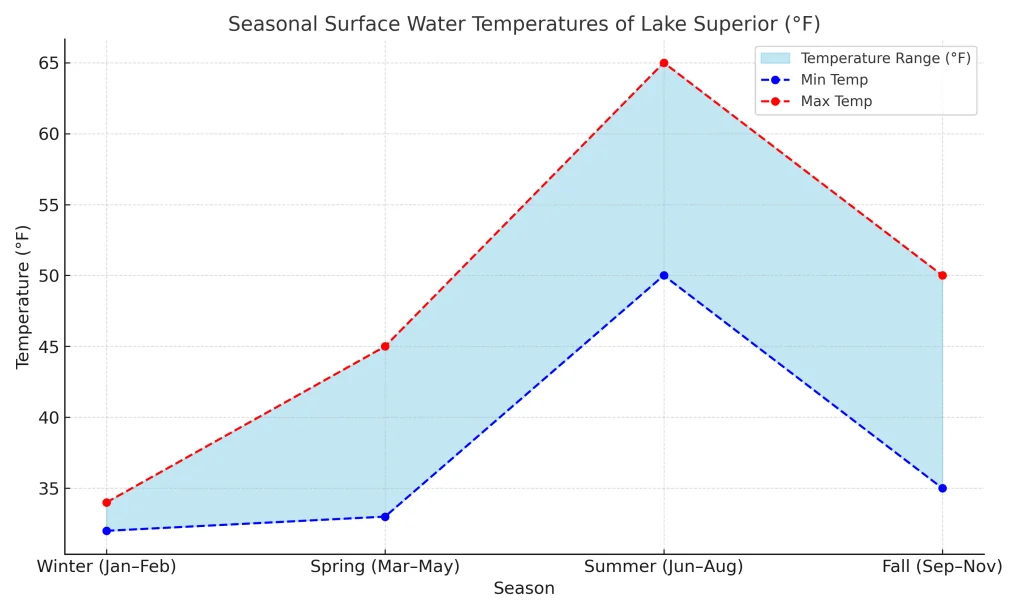
Lake Superior follows a clear seasonal temperature cycle, but it warms and cools much more slowly than smaller lakes. The coldest water temperatures generally occur in February and March, when much of the lake’s surface is close to the freezing point. Water temperatures begin rising gradually in spring, increase more noticeably during summer, and typically reach their highest levels in August before cooling again through fall.
Because Lake Superior is extremely large, temperatures can vary substantially between the open lake and coastal areas. The figures below should therefore be viewed as general lake-wide surface temperature patterns, rather than the exact temperature at every beach or shoreline location. NOAA’s long-term Great Lakes surface temperature data show the lake generally reaching its seasonal peak during late summer.
| Month | Average Surface Water Temperature |
|---|---|
| January | 39°F (3.7°C) |
| February | 37°F (2.7°C) |
| March | 37°F (2.6°C) |
| April | 38°F (3.3°C) |
| May | 40°F (4.4°C) |
| June | 44°F (6.4°C) |
| July | 53°F (11.5°C) |
| August | 59°F (14.8°C) |
| September | 55°F (12.8°C) |
| October | 48°F (9.0°C) |
| November | 43°F (6.3°C) |
| December | 40°F (4.5°C) |
These temperatures represent a broad seasonal pattern, and actual conditions can differ considerably depending on location. For example, NOAA’s coastal monitoring stations show that shallow areas near Duluth and other protected shorelines can become much warmer during summer than the colder offshore portions of Lake Superior.
The most noticeable warming occurs between June and August, while the lake retains much of its summer heat into early fall. By contrast, the water remains near freezing for an extended period during late winter and early spring. This slow seasonal response is one of the defining characteristics of Lake Superior and is largely the result of its enormous size and depth.
Lake Superior Temperature in Summer
Summer is the warmest time of year for Lake Superior, but the lake can still feel remarkably cold compared with most other popular swimming lakes. The water warms gradually through June and July and generally reaches its highest lake-wide surface temperatures in late July and August.
NOAA’s long-term GLSEA data show that Lake Superior’s average lake-wide surface temperature typically peaks at around 61°F (16°C) during late summer. However, temperatures can vary greatly depending on location. Shallow bays, protected beaches, and nearshore areas can become considerably warmer, while the deeper open waters remain much colder.
For example, NOAA coastal temperature records show that the average August water temperature near Duluth can reach about 65°F (18°C), while more exposed locations farther offshore or along colder sections of the shoreline may remain in the low-to-mid 50s°F.
How Warm Does Lake Superior Get?
Lake Superior does not have one single maximum temperature because conditions vary across its enormous surface. During warm summers, some sheltered coastal areas can reach the upper 60s°F (around 20°C), while the open lake generally remains much colder
Lake-wide temperatures can also change rapidly. Strong winds may mix warm surface water with colder water below, causing the surface temperature to drop significantly within a short period. This is one reason Lake Superior can feel pleasantly cool one day and shockingly cold the next.
Is Lake Superior Warm Enough for Swimming?
Lake Superior is warm enough for swimming during the summer, particularly in July and August, but the experience depends heavily on where you enter the water. Sheltered beaches and shallow shoreline areas are generally the most comfortable, while open-water locations can remain cold even on hot summer days.
Swimmers should also remember that Lake Superior’s water temperature can vary sharply over relatively short distances. A warm beach does not necessarily mean the nearby open lake is equally warm, making it important to check local conditions before entering the water.
Lake Superior Temperature in Winter
Winter is when Lake Superior reaches its coldest surface-water temperatures. From late December through early spring, much of the lake’s surface can remain close to the freshwater freezing point of 32°F (0°C). However, the entire lake does not maintain the same temperature, and the open water can remain ice-free even when the surrounding air is well below freezing.
Lake Superior’s maximum ice cover generally occurs between late February and early March. NOAA notes that the lake does not necessarily freeze over completely every year because its enormous volume, depth, winds, and currents influence both water temperature and ice formation.
How Cold Does Lake Superior Get?
The coldest surface water is generally found during late winter and early spring, when temperatures can approach 32°F (0°C). Ice-covered areas can have water immediately beneath the ice near the freezing point, while deeper water remains at different temperatures because of Lake Superior’s complex thermal structure.
Despite extremely cold winter air temperatures, Lake Superior does not freeze completely every year. Its huge volume stores substantial heat, and wind and currents can move relatively warmer water toward the surface, affecting ice formation.
Does Lake Superior Freeze?
Yes, Lake Superior freezes partially during many winters, but complete ice coverage is unusual. Historical records show that its annual maximum ice cover has varied dramatically. NOAA records indicate a maximum of 100% in 1996 and a minimum annual maximum of about 8.5% in 2012 during the historical record cited by NOAA.
In a typical winter, ice begins forming along sheltered bays, harbors, and portions of the shoreline before spreading farther across the lake. The amount of ice ultimately depends on winter temperatures, wind, currents, and other weather patterns.
Why Is Lake Superior So Cold?
Lake Superior remains cold for much of the year because of its enormous size, great depth, northern location, and large volume of water. Unlike shallow lakes that can warm quickly under summer sunlight, Lake Superior requires a tremendous amount of heat to raise its water temperature.
Its depth is particularly important. Deep water remains relatively cold even when the surface warms during summer. In addition, wind-driven circulation can bring colder water from deeper parts of the lake toward the surface, limiting how warm some areas can become. NOAA notes that wind can stir the Great Lakes and help regulate their water temperatures, while persistent winds can also produce coastal upwelling that brings cold bottom water to the surface.
Lake Size and Depth
Lake Superior is the largest and deepest of the Great Lakes, with a maximum depth of about 1,333 feet (406 meters). Its enormous volume of water stores a large amount of heat, so the lake warms and cools much more slowly than smaller, shallower lakes.
Northern Location and Climate
Lake Superior lies in a northern climate where winters are long and cold. The lake loses substantial heat during the colder months, and its surface starts the spring at a very low temperature. Even when surrounding air temperatures rise sharply in summer, the water takes much longer to respond.
Cold Water Can Rise to the Surface
Wind can push warm surface water away from a shoreline and cause colder water from deeper parts of the lake to rise. This process, known as upwelling, can produce sudden drops in nearshore water temperature.
As a result, a beach that feels relatively warm one day can have much colder water after a period of persistent winds.
Surface vs. Deep Water Temperature
Lake Superior does not have the same temperature throughout its entire water column. During the warmer months, surface water becomes considerably warmer than deeper water, creating distinct temperature layers. This difference is especially noticeable during summer, when sunlight warms the upper portion of the lake while deeper water remains cold.
The lake-wide average surface temperature can reach about 61°F (16°C) during the warmest part of summer, while water at greater depths can remain close to 39°F (4°C). The deep water remains relatively stable because freshwater reaches its greatest density at about 39°F (4°C).
The temperature difference between surface and deep water is also important for Lake Superior’s ecosystem. Seasonal mixing occurs as the temperature and density of the upper and deeper layers become more similar, allowing oxygen and nutrients to circulate through the water column. During summer, stronger stratification limits this vertical mixing.
How Climate Change Is Affecting Lake Superior’s Temperature
Lake Superior has experienced a long-term increase in surface water temperature, although the rate of warming varies by season and location. Changes in air temperature, ice cover, and the timing of seasonal warming and cooling all influence the lake’s thermal conditions.
Studies of Lake Superior’s long-term temperature record found that summer surface water temperatures increased by about 2.5°C (4.5°F) between 1979 and 2006. Another study using longer-term evidence estimated an even larger increase of about 3.5°C (6.3°F) in average summer temperature between 1906 and 2006.
Declining winter ice cover is also an important factor. When less of the lake is covered by ice, more open water is exposed to sunlight and can absorb solar energy, contributing to warmer surface temperatures.
Warming water can also affect the lake’s ecosystem. Changes in water temperature and the length of summer stratification can influence dissolved oxygen, nutrient cycling, algae, and the distribution and habitat of fish species.
However, Lake Superior does not warm uniformly. Its enormous size means that temperatures can differ considerably between shallow coastal areas, offshore waters, and deeper parts of the lake.
Lake Superior Temperature Can Vary Greatly by Location
Lake Superior does not have the same water temperature everywhere at the same time. Temperature can vary considerably between the open lake, shallow coastal areas, protected bays, and different parts of the shoreline.
During summer, shallow and protected areas generally warm faster because they receive more solar heating and contain less water to warm. In contrast, deeper offshore areas tend to remain colder because Lake Superior’s large volume and depth slow the warming process.
Wind can also create major short-term differences in water temperature. Persistent winds can push warmer surface water away from one shoreline and bring colder water from deeper layers toward the surface. This process, called upwelling, is particularly noticeable along some exposed shorelines.
Why Can Lake Superior Water Suddenly Feel Colder Near the Shore?
A sudden change in nearshore water temperature can occur when wind-driven upwelling brings cold deeper water to the surface. The effect can be strong enough for water near a beach to become noticeably colder even when the air remains warm.
This is one reason Lake Superior’s water temperature can be difficult to judge from air temperature alone. A warm summer day does not necessarily mean warm lake water, and local conditions can change quickly along the shoreline.
Conclusion
Lake Superior remains one of the coldest large lakes in North America, with water temperatures that change slowly throughout the year. Its enormous size, great depth, northern location, and large volume of water keep the lake cold for much of the year, even when summer air temperatures are warm.
Surface temperatures generally reach their highest levels in late summer, while deeper water remains much colder. Winter brings the lowest temperatures and allows ice to form across parts of the lake, although complete ice coverage is uncommon. Temperature can also vary significantly from one location to another, particularly between shallow coastal areas, protected bays, and the open lake.
For swimmers, boaters, anglers, and visitors, understanding these seasonal and local temperature differences is important. Lake Superior may look calm and inviting on a warm summer day, but its water can remain surprisingly cold, making local water-temperature conditions worth checking before entering the lake.