Acadia National Park is home to some of Maine’s most iconic and historic lighthouses. These maritime beacons, perched on steep cliffs or quiet shorelines, have guided sailors for more than a century through the sometimes-treacherous waters surrounding Mount Desert Island and its neighboring islands.
The lighthouses of Acadia carry stories of shipwrecks, resilience, isolation, and the timeless beauty of Maine’s granite coast. Today, they remain cherished symbols of the region’s maritime heritage and popular destinations for visitors seeking some of the best coastal views in the park.
While only a few lighthouses fall within the park’s boundaries, several others are located on nearby islands and along the surrounding coast. Some can be viewed from public overlooks, while others are best seen by boat or through authorized tours.
Table of Contents
Bass Harbor Head Lighthouse
The Bass Harbor Head Light Station is a historic lighthouse located in Tremont, Maine. Perched on the southwestern tip of Mount Desert Island, the Bass Harbor Head Lighthouse is the most famous lighthouse within Acadia National Park. Established in 1858, it stands as a sentinel overlooking the waters of Blue Hill Bay and the Bass Harbor Bar. Built to help ships navigate these waters, the lighthouse’s white tower rises 32 feet above the ground, and its light shines 56 feet above the high-water mark.

As one of approximately 80 lighthouses across Maine, it stands out as one of the three light stations managed by Acadia National Park, with the other two located on Baker Island and Bear Island.
The structure is constructed from brick and features a cylindrical design, which is typical of many lighthouses built during the mid-19th century. The light originally came from a fifth-order Fresnel lens, a type of lens that uses concentric prisms to focus light into a strong beam. A fourth-order Fresnel lens replaced the original in 1902. Today, the lighthouse remains active and has been automated since 1974. The historic station is managed by the National Park Service, while the U.S. Coast Guard continues to operate and maintain the navigational light.
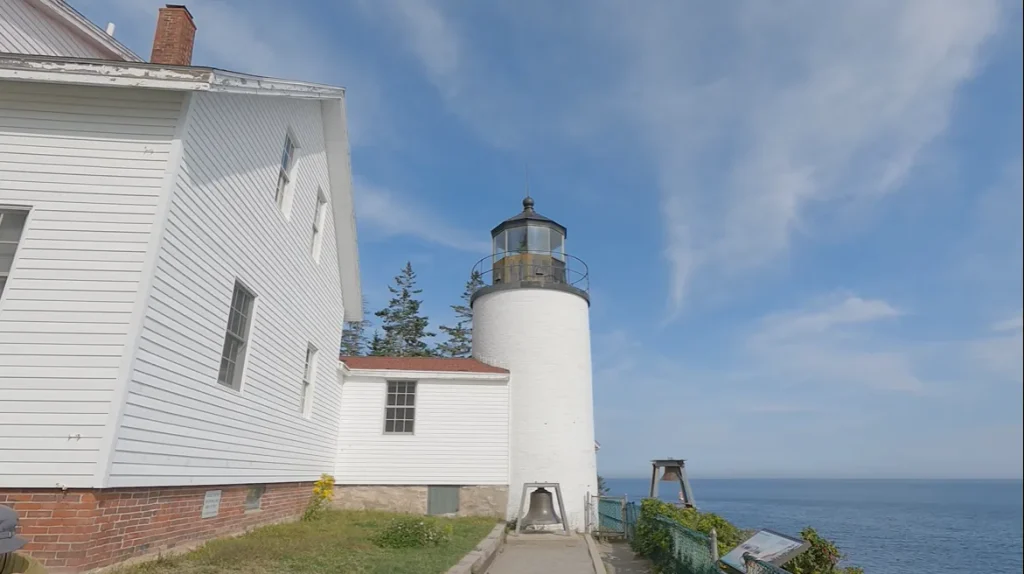
This iconic lighthouse has gained national recognition, appearing on the America the Beautiful quarter in 2012 and the National Park Service centennial postage stamp in 2016. Its significance and historical value were formally acknowledged when it was listed in the National Register of Historic Places in 1988.
Bass Harbor Head Lighthouse Sunrise and Sunset
The setting of Bass Harbor Head Lighthouse makes it especially appealing to photographers. At sunrise, the early light falls across the coastline, creating a quieter atmosphere around the lighthouse and its rocky surroundings. The changing colors of the sky and sea offer a different perspective from the more popular evening views.
Sunset is one of the most popular times to photograph Bass Harbor Head Lighthouse. As the sun lowers over the water, the lighthouse stands out against the colorful sky, making the rocky shoreline a favorite viewpoint for visitors. The area can become particularly crowded during this time, so arriving well before sunset is a good idea.

Visiting Bass Harbor Head Lighthouse
The Bass Harbor Head Lighthouse is not only a functioning navigational aid but also a major tourist attraction. Visitors can explore the grounds and enjoy several viewing areas around the station. A short boardwalk trail from the parking area leads to shoreline viewpoints, while a paved driveway provides another view near the lighthouse. Those seeking a closer look at the rocky shoreline can follow a short gravel path, descend a wooden staircase, and continue down a series of stone steps.

While the interior of the lighthouse is not open to the public, visitors can enjoy views of the lighthouse and the surrounding coastline from the designated viewing areas. The shoreline overlooks Blue Hill Bay, offering excellent opportunities for photography, particularly around sunrise and sunset. The lighthouse sits near Bass Harbor, a charming village known for its fishing community and quiet atmosphere.
Parking is limited, with approximately 27 spaces, and roadside parking is prohibited. The area gets especially busy around sunset, so visitors should allow extra time to find a parking space and follow posted parking rules. An Acadia National Park pass or another valid National Park Service pass is required for parking.
Baker Island Head Light Station
Baker Island Head Light Station stands on Baker Island, one of the five Cranberry Isles, south of Mount Desert Island in Frenchman Bay. Established to guide ships through the hazardous waters near the Cranberry Isles, it was among the earliest light stations in the Mount Desert Island area. Its isolated island setting also reflects the challenges faced by lighthouse keepers who once maintained these coastal navigation stations.
The first lighthouse on Baker Island was constructed in 1828, during the presidency of John Quincy Adams. William Gilley, an early island resident, became its first keeper. The original structure was replaced in 1855 by the present brick lighthouse and a wood-framed keeper’s dwelling. Over the following decades, additional buildings—including an oil house, signal station, and fuel house—were added to support the light station’s operations.
The current tower is a white, cylindrical brick structure approximately 43 feet tall, topped by a black lantern room. Its light was automated in 1966, ending the need for a full-time keeper. The U.S. Coast Guard continues to maintain the light as an active aid to navigation, while the National Park Service manages the historic light station.
Baker Island Light Station is also an important part of Maine’s maritime heritage. The historic property was listed individually on the National Register of Historic Places in 1988, recognizing its architectural character and role in the development of coastal navigation. Today, the surrounding island preserves not only the lighthouse complex but also remnants of the community that once lived and worked there.
Visiting Baker Island Head Light Station
Baker Island has no public dock, so reaching the island requires a boat capable of landing near its shore. Visitors can explore the light station and surrounding historic landscape through authorized National Park Service guided tours when available. The lighthouse tower itself is not open to the public, and visitors can view it from the outside. Because tour schedules and access arrangements can vary by season, check current options before planning a visit.
Bear Island Head Light Station
Bear Island Head Light Station is situated on Bear Island, southeast of Northeast Harbor and just off the eastern coast of Mount Desert Island. It stands above a rocky shoreline near the entrance to Northeast Harbor and Somes Sound, where its elevated position helped mariners navigate the surrounding waters. The island is part of the Cranberry Isles, a group of five islands off the coast of Maine.
The lighthouse was authorized in 1839 under President Martin Van Buren to improve navigation into Northeast Harbor. The original structure combined a stone keeper’s dwelling with a small light tower. After it burned in 1852, a new brick tower was constructed in 1853. The station underwent a major rebuilding in 1889, when the present lighthouse and its associated buildings took shape.
The present tower is a white, cylindrical brick structure approximately 31 feet tall, with a black lantern. It stands on a rocky elevation, giving the light a focal height of about 101 feet above the water. A fifth-order Fresnel lens was installed in 1856, and a fog bell was added later to help guide vessels during poor visibility. The station’s historic complex also includes a keeper’s house, barn, oil house, and boathouse.
Bear Island Light was deactivated in the early 1980s. With the help of Friends of Acadia, the light was relit in 1989 as a private aid to navigation. The National Park Service manages a portion of the island, while the historic light station is privately leased and closed to public access. The station was listed on the National Register of Historic Places in 1988, recognizing its architectural and maritime significance.
Viewing Bear Island Head Light Station
Unlike Bass Harbor Head Lighthouse, Bear Island Light Station is not open for public visits. The lighthouse and its associated grounds are privately leased, and the property is closed to public access. Visitors can admire the lighthouse from the water on boat trips around the Cranberry Isles, but landing on the island or visiting the buildings is not permitted.
Prospect Harbor Point Lighthouse
Prospect Harbor Point Lighthouse stands at the eastern entrance to Prospect Harbor in Gouldsboro, Maine, near the Schoodic Peninsula. Also known as Prospect Harbor Light, it overlooks a sheltered harbor that supported an active fishing fleet during the 19th century. The lighthouse was established to help fishing boats and other vessels navigate safely into the harbor, particularly along this rocky stretch of the Maine coast.
The light station was established in 1850. Its original structure was a 35-foot rubble-stone tower, constructed in 1848. However, the lighthouse was discontinued for a period because officials believed the harbor was not being used enough to justify its operation. As maritime activity increased, the light was reestablished in 1870, and a fifth-order Fresnel lens was installed to improve its visibility.
The present lighthouse was built in 1891, replacing the earlier stone tower. It is a 38-foot conical wooden structure with white exterior walls and a black lantern. A separate keeper’s house was constructed alongside the tower, and an oil house was added in 1905. The station was automated in 1934, although lighthouse keepers continued living on the property for several more years. Its original Fresnel lens was eventually replaced by a modern optic in 1951.
Prospect Harbor Point Lighthouse remains an active aid to navigation and is recognized for its contribution to Maine’s maritime history. The historic light station was added to the National Register of Historic Places in 1988. Its traditional wooden tower and keeper’s house make it a distinctive example of late-19th-century lighthouse architecture in coastal Maine.
Viewing Prospect Harbor Point Lighthouse
The lighthouse is located on a restricted U.S. Navy installation and is not open to public entry. Visitors can view it from across Prospect Harbor or from permitted public areas near the installation’s entrance. Its harbor-side setting offers opportunities for photographs, particularly when fishing boats and coastal scenery are visible in the foreground. Visitors should remain outside restricted areas and follow posted access rules.
Great Duck Island Lighthouse
Great Duck Island Lighthouse stands at the southern end of Great Duck Island, approximately nine miles south of Mount Desert Island in the waters off the coast of Maine. Located near the approach to Blue Hill Bay, the lighthouse was built to guide vessels navigating this offshore stretch of the Atlantic, where rocky shores and frequent fog created challenging conditions for mariners. Although it is often associated with the Acadia region, Great Duck Island is not within Acadia National Park.
The idea of establishing a lighthouse on Great Duck Island dates back to 1823, but construction did not begin until much later. The light station was completed in 1890, when the growing maritime traffic around Mount Desert Island and Frenchman Bay increased the need for reliable navigation aids. The original complex included the lighthouse tower, three keepers’ houses, a fog signal building, an oil house, and other support structures.
The lighthouse is a cylindrical brick tower approximately 42 feet tall, with a white exterior and a black lantern. Its original lighting system used a fifth-order Fresnel lens, which was replaced by a fourth-order lens in 1902. A fog signal also helped warn ships during periods of poor visibility. The station was automated in 1986, ending the era of resident lighthouse keepers.
Great Duck Island is also significant for its wildlife. Its remote location and relatively undisturbed habitat make it an important nesting area for seabirds, including thousands of nesting birds during the breeding season. The Nature Conservancy and the State of Maine jointly own much of the island, while the College of the Atlantic owns approximately 12 acres containing the historic lighthouse property and operates a field research station there. The Great Duck Island Light Station was listed on the National Register of Historic Places in 1988.
Viewing Great Duck Island Lighthouse
Great Duck Island is not generally open to the public because of its protected wildlife habitat and research activities. Visitors can best see the lighthouse from the water on boat cruises around the island. Landing opportunities are restricted, and access should not be assumed to be available through ordinary sightseeing tours. A boat trip offers views of the lighthouse, its keeper’s house, and the island’s rugged shoreline without disturbing its sensitive nesting habitat.
Egg Rock Lighthouse
Egg Rock Lighthouse stands on a small, rocky island at the entrance to Frenchman Bay, between Mount Desert Island and the Schoodic Peninsula in Maine. Its position helped guide vessels through a busy stretch of water where submerged rocks, fog, and changing sea conditions posed risks to navigation. The island’s exposed location also made it an important landmark for boats approaching the surrounding coastal communities.
The lighthouse was established in 1875 as maritime traffic increased around Frenchman Bay, particularly with the growth of summer travel to Bar Harbor. Unlike many traditional light stations, Egg Rock has an unusual design: its square brick tower rises through the center of the keeper’s dwelling rather than standing separately beside it. The main building is a white, one-and-a-half-story structure with a red roof, making the lighthouse distinctive among Maine’s coastal lights.
The tower stands approximately 40 feet tall, with its light positioned about 64 feet above sea level. Its original lighting system used a fifth-order Fresnel lens. A steam-powered fog signal building was added in 1904 to help warn vessels during periods of poor visibility. The lighthouse was automated in 1976, ending the need for resident keepers. It continues to operate as an active aid to navigation.
Egg Rock is also important for its seabird habitat. The island provides nesting grounds for species such as double-crested cormorants, common eiders, herring gulls, and black guillemots. Today, it is protected as part of the Maine Coastal Islands National Wildlife Refuge, managed by the U.S. Fish and Wildlife Service. The historic light station was listed on the National Register of Historic Places in 1988.
Viewing Egg Rock Lighthouse
Although Egg Rock Lighthouse is not open for public visits, it can be viewed from several locations around Acadia. One convenient land-based viewpoint is the Schooner Head Overlook, where the lighthouse can be seen across Frenchman Bay on clear days. Sightseeing cruises and boat tours from Bar Harbor offer a closer view of the island, its lighthouse, and surrounding seabird habitat. Landing on the protected island is not part of an ordinary sightseeing visit.