The name Mississippi has a history that stretches back thousands of years, long before the United States existed. Rooted in an Indigenous word meaning “Great River,” the name was first recorded by French missionaries in the 17th century. As European explorers and mapmakers adopted it, the original word passed through different spellings before taking the familiar form used today.
Yet the river’s naming history does not end with the word Mississippi. Different Indigenous nations had their own names for this mighty waterway, while European explorers introduced several alternative names. Even its famous nickname, “Father of Waters,” has a fascinating history. Together, these names reveal how the Mississippi River’s identity developed through the languages and cultures of North America.
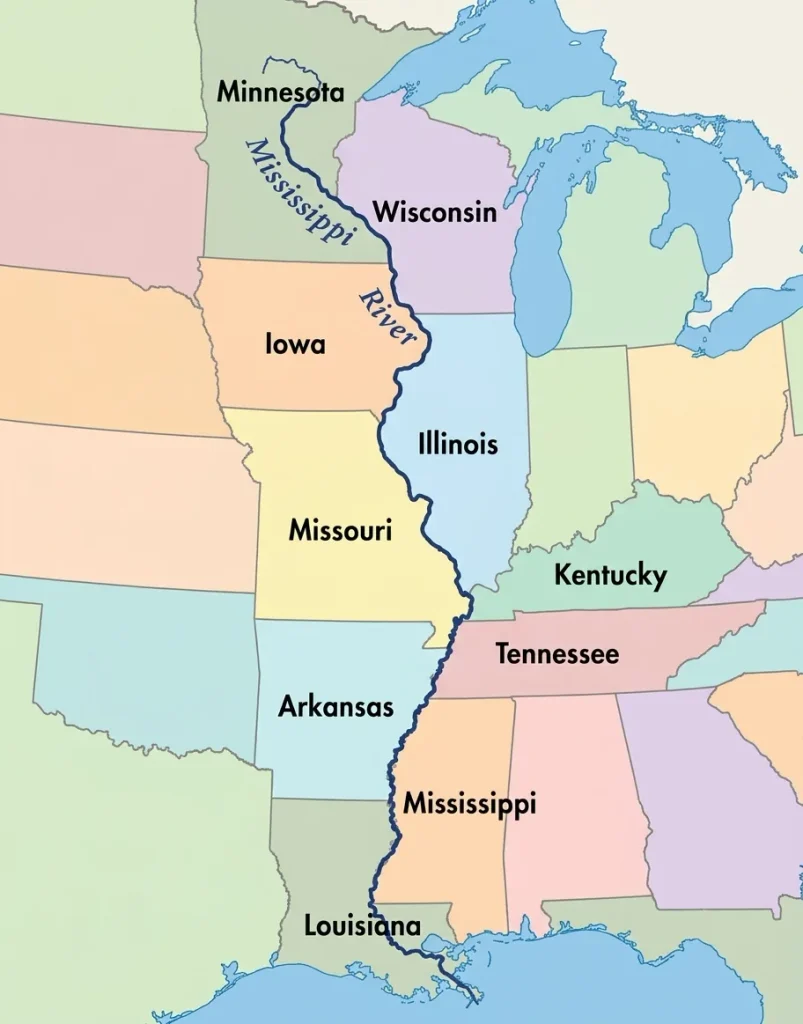
Table of Contents
How Did the Mississippi River Get Its Name?
The Mississippi River gets its name from an Indigenous Algonquian language, with linguistic research tracing it more specifically to the Old Ottawa form missi-si·pi, meaning “large river” or “great river.” The name was known in the northern Great Lakes region long before French missionaries began recording it in the 17th century. Its earliest known written forms appeared in French missionary accounts, preserving an Indigenous name that would eventually become widely used for the entire river.
The word missi-si·pi consists of two elements: missi, meaning “large” or “great,” and si·pi, meaning “river.” Together, they describe a great waterway, an apt name for the river that flows from northern Minnesota to the Gulf of Mexico. The expression also has close linguistic parallels in other Anishinaabe languages, particularly Ojibwe, where misi means “large” or “great” and ziibi means “river.” This similarity explains why the name is often attributed to Ojibwe, also known as Chippewa, although linguistic research points more specifically to Old Ottawa as the source of the recorded form.
Ottawa and Ojibwe belong to the Anishinaabe branch of the Algonquian language family. Although they are closely related and share similarities in vocabulary, they are distinct languages with their own forms. Recognising this distinction helps clarify the origin of the name and explains why the familiar Ojibwe interpretation and the more precise Old Ottawa explanation are closely connected without being identical.
The name entered European written records through Indigenous knowledge shared with French missionaries in the northern Great Lakes region. Jesuit missionary Father Claude Allouez recorded an early form of the name in the 1660s, providing some of the first written evidence of the Indigenous word that eventually developed into Mississippi.
Indigenous Names for the Mississippi River
Long before the name Mississippi became widely established, Indigenous nations across the Mississippi Valley and surrounding regions had their own names for the river. These names reflected different languages, cultural traditions and relationships with the waterway. Because the river passed through the homelands of many Indigenous communities, no single name was used by all of them.
Among the recorded names, the Caddo people used Báhat Sássin, meaning “Mother of Rivers.” In Lakota, the river was known as Ȟaȟáwakpa, translated as “River of the Falls.” The Ojibwe name Misi-Ziibi means “Great River,” closely reflecting the meaning of the Old Ottawa form associated with the name Mississippi. The Cheyenne name Ma’xeé’ome’tää’e has been translated as “Big, Greasy River,” while the Choctaw name Misha Sipokni means “Beyond Age.”
Other Indigenous languages also preserved distinct names for the waterway. These include Mihcisiipiiwi in Miami-Illinois, Mäse’sibowi in Fox-Sauk, and Ny-tonks in Quapaw, where it is translated as “Great River.” The names demonstrate the linguistic diversity of the communities connected to the Mississippi, although translations are not available for every recorded form.
Together, these names provide a broader understanding of the Mississippi River’s history and cultural significance. They show that Mississippi represents just one part of a much wider Indigenous naming tradition shaped by the many nations that have lived along, travelled across and depended on the river.
How French Explorers First Recorded the Name Mississippi
The name Mississippi began appearing in European written records during the 17th century, when French missionaries gathered information about the lands and Indigenous communities around the Great Lakes. One of the earliest known written forms was Messipi, recorded by Jesuit missionary Father Claude Allouez in the Jesuit Relation for 1666–1667. His account provides an important early reference to the river’s Indigenous name, which French missionaries learned through their interactions with Native communities long before the major French expedition of 1673.
At the time, Allouez was based at the Mission of the Holy Spirit near Chequamegon Bay on Lake Superior, in present-day Wisconsin. His report mentioned visiting Sioux, whom the French called Nadouésiouek, and described them as living west of the mission towards a great river called Messipi. The passage is particularly valuable because it records both the river’s name and the geographical knowledge Indigenous communities had shared with the French missionaries.
Allouez recorded another form, Messi-Sipi, in a report from 1670. During his missionary travels among Indigenous communities along the Fox River in present-day Wisconsin, he noted that the great river could be reached after a journey of six days. The different spellings, Messipi and Messi-Sipi, illustrate how French writers represented an Indigenous name using the spelling conventions of their own language.
The name became more prominent in European geographical accounts following the 1673 expedition of Louis Jolliet and Father Jacques Marquette. Travelling from the Great Lakes through Green Bay, the Fox River and the Wisconsin River, the explorers reached the Mississippi on June 17, 1673. They travelled south, passing the Missouri and Ohio river confluences, and continued as far as the region near the mouth of the Arkansas River. After receiving warnings about the Spanish presence farther south, they turned back in July. Their journey provided Europeans with much more detailed geographical information about the river and its surrounding lands.
Marquette’s 1673 map also preserves an alternative French name for the waterway: Rivière de la Conception, or River of the Conception. The Wisconsin Historical Society identifies the map as depicting the Mississippi, also called the Conception River. This designation reflects the French practice of assigning religious names to geographical features during exploration. However, the Indigenous-derived name Mississippi remained in use and continued to appear in subsequent European maps and written accounts, eventually becoming the river’s established name.
How Did the Spelling Change to Mississippi?
The name Mississippi did not always have its present spelling. When French missionaries and explorers first recorded the Indigenous name in the 17th century, they wrote it according to how they heard it and the spelling conventions of their own language. As a result, early written accounts and maps contained several variations, including Messipi, Messi-Sipi, Mitchisipi, Meschasipi and Missisipi. These forms show how the Indigenous name gradually developed into a written form used by European missionaries, explorers and mapmakers.
One of the earliest documented forms was Messipi, recorded by Jesuit missionary Claude Allouez in the Jesuit Relations of 1666–1667. In a report from 1670, he used Messi-Sipi. A map associated with Jacques Marquette’s 1672–1673 exploration of the Mississippi Valley preserves another form, R. Mitchisipi. Marquette’s surviving map records also associate the river with the French designation Rivière de la Conception. Together, these records illustrate the variation in names and spellings found in early French geographical documents.
Other French writers and mapmakers introduced further variations. Louis Hennepin’s map, published in 1698, used the form Meschasipi. French cartographer Guillaume Delisle used Mississipi on his maps, including his 1718 Carte de la Louisiane et du cours du Mississipi, now held by the Library of Congress. These spellings retained the same Indigenous-derived name but differed in the number and arrangement of letters.
The name also entered English-language geographical writing during this period. In 1722, British writer Daniel Coxe published A Description of the English Province of Carolana, whose title referred to the river as the Meschacebe or Missisipi. This is an important example of the name appearing in an English publication, although its spelling still differed from the modern form.
The spelling Mississippi, with double “s” and double “p,” appears in Jonathan Carver’s Travels Through the Interior Parts of North-America, published in 1778. Carver’s book provides an early printed example of the modern spelling. Its adoption was not the result of a single official change; rather, the form gradually became established through continued use in American writing, maps and geographical records.
Why Is the Mississippi River Also Called the “Father of Waters”?
The Mississippi River is widely known as the “Father of Waters,” a nickname that reflects its immense size and the extensive network of rivers that feed into it. However, this expression is not the literal translation of the name Mississippi. The river’s name is traced to an Indigenous word meaning “large river” or “great river,” while “Father of Waters” has a separate historical origin.
One of the earliest well-known explanations of this expression appeared in the work of French writer Antoine-Simon Le Page du Pratz. In his original French book, Histoire de la Louisiane, published in 1758, he discussed the Indigenous form Meact-Chassipi. In the English translation, The History of Louisiana, published in 1763, he interpreted this expression as meaning “The Ancient Father of Rivers.” Du Pratz attributed the name to Indigenous people of the north and suggested that the French had gradually altered its pronunciation into Mississippi.
Du Pratz’s explanation is an important part of the nickname’s history, but it is not the accepted linguistic origin of the word Mississippi. Modern linguistic research traces the recorded name to the Old Ottawa form missi-si·pi, meaning “large river.” The familiar expression “Great River” therefore reflects the name’s linguistic meaning, whereas “Ancient Father of Rivers” represents Du Pratz’s historical interpretation.
The nickname is also fitting because of the Mississippi’s enormous drainage system. The river receives water from hundreds of tributaries, including major waterways such as the Missouri, Ohio and Arkansas rivers. Its drainage basin covers approximately 1.2 million square miles (3.1 million square kilometres), extending across much of the central United States. This vast network connects numerous smaller streams and major rivers to one of North America’s largest river systems.
The expression also became part of American political and historical language. On August 26, 1863, following the Union victories at Vicksburg and Port Hudson, President Abraham Lincoln wrote to his friend James C. Conkling: “The Father of Waters again goes unvexed to the sea.” His words referred to the restoration of Union control over the Mississippi, a crucial transportation and trade route during the American Civil War. The capture of Vicksburg had been particularly significant because it gave the Union control of a strategically important stretch of the river.
Today, “Father of Waters” remains one of the Mississippi River’s best-known nicknames. The expression recalls both the river’s vast tributary network and its historical importance as a major waterway connecting communities, landscapes and economies across the United States.
What Other Historical Names Were Used for the Mississippi River?
Before Mississippi became the river’s widely established name, Spanish and French explorers, missionaries and mapmakers recorded several alternative names for the waterway. These designations reflected religious beliefs, political honours and the European practice of assigning new names to geographical features during exploration.
One early Spanish name associated with the Mississippi was Río del Espíritu Santo, meaning “River of the Holy Spirit.” According to the historical account of Alonso Álvarez de Pineda’s 1519 Gulf Coast expedition, he gave this name to a large river he encountered near the Gulf of Mexico, often identified as the Mississippi, although that identification has been debated. The name also appeared on early Spanish maps. However, later Spanish records sometimes extended the related name Espíritu Santo to nearby coastal waterways and bays, making it important to distinguish the original river designation from its subsequent geographical use.
French explorers and mapmakers introduced several other names during the 17th century. In 1673, Jacques Marquette’s map identified the Mississippi as Rivière de la Conception, a religious designation referring to the Immaculate Conception. The following year, Louis Jolliet’s map used Rivière de Buade, honouring Louis de Buade, Count of Frontenac, the governor of New France. The map was dedicated to Frontenac, who had supported the expedition undertaken by Jolliet and Marquette.
Another name associated with French efforts to honour influential officials was Rivière Colbert, referring to Jean-Baptiste Colbert, a powerful minister under King Louis XIV. The name appeared in French cartographic records associated with mapmaker Jean-Baptiste Franquelin, including a map that described the Mississippi as Mississipi, ou Rivière Colbert (Mississippi, or Colbert River). This naming reflected the French practice of honouring officials who supported exploration and colonial expansion in North America. It should be distinguished from Rivière de Buade, which appeared on Jolliet’s 1674 map and honoured Louis de Buade, Count of Frontenac.
The name St. Louis also appeared in French geographical records. In 1718, French cartographer Nicolas de Fer published a map titled Le cours de Missisipi, ou de St. Louis, meaning “The Course of the Mississippi, or of St. Louis.” The map’s title provides clear evidence that St. Louis was used as an alternative designation for the river in some French geographical records during the early 18th century.
Despite these alternatives, the Indigenous-derived name Mississippi continued to appear in European accounts and maps. Over time, it became the established name of the river, while the Spanish and French designations remained part of the historical record of its exploration and mapping.
Was the State of Mississippi Named After the River?
Yes. The U.S. state of Mississippi was named after the Mississippi River. The river’s name had been in use for generations before the United States established the territory that eventually became the state.
On April 7, 1798, President John Adams signed legislation establishing the Mississippi Territory, named after the major river that formed its western boundary. At that time, the territory covered an area that included much of present-day Mississippi and Alabama. Its boundaries changed over the following years as the United States organised and expanded its territorial administration.
In 1817, the territory was divided. Its eastern portion became the Alabama Territory, while the western portion proceeded toward statehood as Mississippi. On December 10, 1817, President James Monroe signed the resolution admitting Mississippi to the Union as the 20th state. The new state retained the name already used for the territory.
The name passed from the Mississippi River to the Mississippi Territory in 1798 and was retained when the territory became the 20th U.S. state in 1817.