Acadia National Park is home to wildlife that can pose risks to visitors, from wild mammals such as black bears and coyotes to smaller hazards such as ticks and browntail moth caterpillars. Some animals can cause injuries through bites, defensive behavior, or physical contact, while others may expose people to tick-borne diseases or irritating hairs. Although serious encounters with large wildlife are uncommon, knowing which animals to watch for can help visitors avoid unexpected problems.
The risks vary depending on the species and where visitors encounter it. Deer may cross park roads, ticks are found in grassy and wooded areas, and animals such as moose and black bears can be unpredictable if approached or startled. This guide covers the dangerous animals found in and around Acadia National Park, how to identify them, where they typically live, the risks they pose, and how to stay safe during a visit.
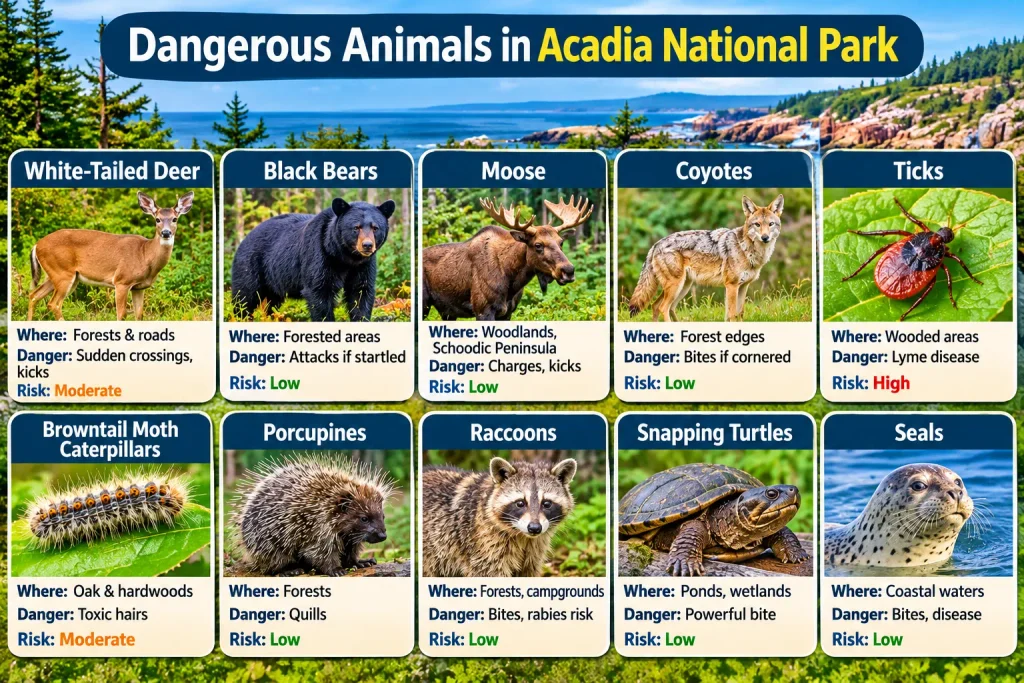
Table of Contents
Quick Reference: Dangerous Animals in Acadia National Park
| Animal | Where You May Encounter It | Main Danger | Relative Visitor Concern |
|---|---|---|---|
| White-Tailed Deer | Forest edges, open areas, and park roads | Sudden road crossings, kicks when threatened | Moderate |
| Black Bears | Forested areas of Mount Desert Island | Defensive attacks, especially when startled or protecting cubs | Low |
| Moose | Rarely encountered; more likely on the Schoodic Peninsula | Charges, kicks, and trampling | Low |
| Coyotes | Forest edges, brushy areas, and woodland openings | Bites if cornered or threatened | Low |
| Ticks | Wooded trails, leaf litter, brush, and grassy areas | Lyme disease and other tick-borne illnesses | High |
| Browntail Moth Caterpillars | Infested trees and vegetation, particularly oak and other hardwoods | Toxic hairs that cause skin rashes and respiratory irritation | Moderate |
| Porcupines | Forests and wooded areas throughout the park | Barbed quills that can cause painful injuries | Low |
| Raccoons | Forests, campgrounds, and areas near food sources | Bites, scratches, and possible rabies exposure | Low |
| Snapping Turtles | Freshwater ponds, lakes, wetlands, and nearby roads | Powerful bites when threatened on land | Low |
| Seals | Coastal waters, rocky shorelines, and nearby islands | Bites and infections from direct contact | Low |
Risk levels are general comparisons for visitors, not official park classifications. Actual risk depends on the animal’s behavior, the location, and how closely people approach it. Tick and browntail moth exposure can also vary considerably by season and local conditions.
White-Tailed Deer in Acadia National Park
White-tailed deer are among the most frequently seen large mammals in Acadia National Park. Although they are generally not aggressive toward people, they can still pose a danger, particularly when they suddenly cross roads or feel threatened by someone approaching too closely. Their presence along park roads and trails makes it important for visitors to recognize them and give them plenty of space.
White-tailed deer have a reddish-brown coat during summer that becomes thicker and more grayish-brown in winter. Their most recognizable feature is the white underside of the tail, which becomes clearly visible when the animal raises it while running. Adult males, known as bucks, grow antlers that are shed and regrown each year, while females, called does, generally do not have antlers.
These deer typically inhabit forests, woodland edges, brushy areas, and open meadows where they can find food and cover. In Acadia, they are plentiful on Mount Desert Island, and visitors have a good chance of spotting them around the Sieur de Monts area and along carriage roads, particularly at dawn and dusk.
The main danger to visitors comes from deer crossing roads unexpectedly. A collision with a deer can cause serious vehicle damage and injuries to drivers and passengers. Deer are especially active around dawn and dusk, so drivers should reduce their speed, watch road edges carefully, and be prepared to stop if a deer appears. If one deer crosses the road, watch for others following behind.
Although deer usually avoid people, they can kick if cornered, startled, or approached too closely. Does may also become defensive when protecting their fawns. Never approach or attempt to touch a deer, even if it appears calm. If you see a fawn resting alone, leave it undisturbed; its mother may be nearby and will usually return.
Black Bears in Acadia National Park
Black bears are among the largest and potentially dangerous mammals found in Acadia National Park. Although they generally avoid people, they can become defensive if startled, approached too closely, or disturbed while feeding or protecting their cubs. Bear encounters are uncommon on Mount Desert Island, but visitors should know how to recognize these animals and respond safely if they encounter one.
American black bears have a stocky body, rounded ears, a long snout, and short legs with strong claws. Despite their name, their fur is not always black; some bears can have brown or cinnamon-colored coats. Adult bears can weigh several hundred pounds, with males generally larger than females. Their powerful bodies, sharp claws, and strong jaws make close encounters potentially dangerous.
Black bears typically inhabit forested areas with dense vegetation, where they can find food and shelter. Their diet includes berries, nuts, roots, insects, and other natural food sources. A small permanent population of black bears lives on Mount Desert Island, although sightings are uncommon. The National Park Service reports that bears are present throughout Acadia but are infrequently spotted. The Schoodic Peninsula is also connected to mainland Maine, and bears may occur in that part of the park as well.
The greatest risk arises when a bear is surprised at close range, feels threatened, or becomes accustomed to human food. A female bear with cubs can be particularly defensive if she believes her young are in danger. Bears may also visit campsites or picnic areas when food, garbage, or pet food is left unsecured, increasing the chance of an unwanted encounter.
If you see a black bear, do not approach it, follow it, or attempt to take a closer photograph. Acadia National Park requires visitors to stay at least 50 yards away from bears. If a bear approaches, remain calm, avoid running, and slowly back away while giving it an escape route. Keep children close and dogs leashed. Store food and scented items in designated hard-sided food lockers or an enclosed vehicle when they are not in use. Bear spray is permitted in the park for protection against aggressive wildlife.
Moose in Acadia National Park
Moose are among the largest and most powerful mammals in Maine, and an encounter with one can be dangerous. Although they are capable of seriously injuring people, visitors to Acadia National Park are unlikely to see them. There is no established moose population on Mount Desert Island, where most of the park is located. Occasional animals may wander into the area, while the mainland-connected Schoodic Peninsula offers a slightly better chance of a sighting.
Moose are easy to recognize because of their enormous size, long legs, humped shoulders, and large, overhanging muzzle. Their coats are usually dark brown, and adult males grow broad, flattened antlers that can span several feet. Females do not have antlers and are generally smaller than males. Despite their size, moose can move quickly and may run or charge when they feel threatened.
In Maine, moose typically inhabit forests, wetlands, wooded areas, and places near lakes and ponds, where they feed on leaves, twigs, and aquatic plants. They prefer areas with plenty of vegetation and access to water. Within Acadia, however, sightings are very rare, particularly on Mount Desert Island. The Schoodic Peninsula has a somewhat greater possibility of sightings because it is connected to the mainland, but moose generally favor larger, less disturbed inland habitats.
A moose can become dangerous when startled, approached, or threatened. Females may aggressively defend their calves, while males can become more unpredictable during the fall breeding season, known as the rut. Warning signs include flattened ears, raised hair along the neck or shoulders, licking of the muzzle, and a lowered head. A threatened moose may charge, kick, or stomp, potentially causing severe injuries.
If you encounter a moose, never approach it for a photograph or attempt to get closer. Give it plenty of room and move away slowly. If it approaches or charges, get behind a large tree, vehicle, or other solid barrier. Never stand between a cow and her calf. Although a moose sighting in Acadia is unusual, visitors should treat any encounter with caution.
Coyotes in Acadia National Park
Coyotes are wild predators found in Acadia National Park, although visitors rarely see them. They generally avoid people and do not pose a major threat to hikers, but they can become dangerous if approached, cornered, or accustomed to human food. Their sharp teeth and strong jaws can cause serious bite injuries, particularly if an animal feels threatened or tries to defend its young.
Coyotes resemble medium-sized dogs but have several distinctive features. They typically have a slender body, pointed ears, a narrow muzzle, and a bushy tail with a dark or black tip. Their fur is usually a mixture of gray, brown, tan, and sometimes reddish shades. Eastern coyotes can be larger than western coyotes because of their mixed ancestry, although their size varies.
Coyotes are adaptable animals that typically inhabit forest edges, open fields, brushy areas, and woodland clearings. They use these habitats for hunting, finding shelter, and raising their young. In Acadia, the National Park Service has documented coyotes, with signs of their presence found around the park. They are seldom seen, however, because they are generally secretive and tend to avoid people.
The main risk comes from getting too close to a coyote or allowing it to become comfortable around humans. Coyotes may bite if cornered or threatened, and they can also pose a risk to small pets. The danger is greater when people attempt to feed, approach, or photograph them at close range. Coyotes may be more protective around their young during the breeding and pup-rearing seasons.
If you encounter a coyote, keep your distance and never approach or feed it. Keep dogs on a leash no longer than six feet, as required in Acadia, and do not allow pets to chase wildlife. If a coyote approaches, stand your ground, make yourself appear larger, speak firmly, and slowly back away without turning your back or running. Give the animal an opportunity to leave.
Ticks in Acadia National Park
Ticks are among the most important wildlife-related health hazards in Acadia National Park. Unlike large animals, they are difficult to notice because of their tiny size, but their bites can transmit diseases that cause serious health problems. The National Park Service warns visitors that ticks are prevalent in Acadia and are mostly active from late spring to early fall. Dogs and other pets can also pick up ticks while exploring the park.
The black-legged tick, also known as the deer tick (Ixodes scapularis), is especially important because it can transmit Lyme disease. Adult black-legged ticks are very small, with reddish-brown bodies and dark legs. Nymphs, which are even smaller—roughly the size of a poppy seed—can be particularly difficult to detect. Other species, including American dog ticks, also occur in Maine.
Ticks typically live in wooded areas, forest edges, brush, and places with leaf litter or low vegetation. They usually remain close to the ground or climb onto low vegetation, waiting for an animal or person to pass. Research conducted in Acadia found that black-legged tick populations are unevenly distributed throughout the park. Higher tick densities were associated with deciduous forest cover and relatively low elevations, particularly in the northeastern part of Mount Desert Island.
An infected black-legged tick can transmit Lyme disease, anaplasmosis, babesiosis, and other infections, including Powassan virus disease. Lyme disease is the best-known tick-borne illness in Maine. Symptoms can include fever, headache, fatigue, muscle and joint aches, and sometimes an expanding rash. Not every tick carries an infection, but even a single infected tick bite can cause illness. Some tick-borne diseases can become serious if they are not recognized and treated promptly.
Visitors can reduce their risk by wearing long pants, closed-toe shoes, and light-colored clothing that makes ticks easier to spot. Use an appropriate EPA-registered insect repellent and consider wearing clothing treated with permethrin according to product directions. Stay on established trails when possible and avoid brushing against tall grass and dense vegetation. After hiking, check your entire body, clothing, and pets for ticks, paying particular attention to the scalp, behind the ears, under the arms, around the waist, and behind the knees. Remove attached ticks promptly with fine-tipped tweezers by grasping them close to the skin and pulling steadily upward. If you develop a rash, fever, or flu-like symptoms after a tick bite, seek medical advice.
Browntail Moth Caterpillars in Acadia National Park
Browntail moth caterpillars are an important health hazard for visitors to Acadia National Park because their microscopic hairs can cause painful skin rashes and respiratory problems. Unlike animals that pose a danger through bites or attacks, these caterpillars can affect people without direct contact. Their toxic hairs can become airborne, settle on vegetation, and remain in the environment long after the caterpillars have left an area.
Browntail moth caterpillars are approximately 1.5 inches long and have dark brown bodies covered with fine hairs. Older caterpillars have two broken white stripes running along their sides and two distinctive reddish-orange spots near the rear of their bodies. These markings help distinguish them from other hairy caterpillars found in Maine.
The caterpillars feed on the leaves of broadleaf trees and shrubs, particularly oak, apple, birch, cherry, and other hardwood species. They build noticeable white, silken winter webs in the branches of host trees, where they remain during colder months. In Acadia, browntail moths have been documented on Mount Desert Island and the Schoodic Peninsula. The National Park Service has also conducted management efforts to monitor and reduce their impact in the park.
The main danger comes from the caterpillars’ tiny, barbed hairs, which contain a toxin that irritates human skin and airways. Contact with these hairs can cause an itchy, poison ivy-like rash that may last from several hours to several weeks. Inhaling airborne hairs can lead to coughing, breathing difficulties, or respiratory distress. The hairs are also present on shed caterpillar skins and pupal cocoons, so avoiding the caterpillars themselves does not completely eliminate the risk.
The greatest risk of exposure occurs between April and July, when caterpillars are active and shedding their hairs. However, the hairs can remain toxic in the environment for one to three years and may become airborne when disturbed. Visitors should avoid touching caterpillars, their webs, or suspicious hairy material on trees and vegetation. Wearing long sleeves and pants can reduce skin exposure, while avoiding heavily infested areas during periods of high activity provides additional protection. If you suspect exposure, shower and change clothes after leaving the affected area. Seek medical advice if you develop a severe rash or breathing problems.
Porcupines in Acadia National Park
Porcupines are slow-moving rodents found throughout Acadia National Park, but their defensive quills can cause painful injuries to people and pets. They do not normally attack humans and usually try to retreat when disturbed. However, a porcupine may turn its back and swing its quill-covered tail toward an approaching animal or person if it feels threatened. The greatest concern is often for dogs that investigate or attempt to bite these animals.
North American porcupines have stocky bodies, short legs, small rounded ears, and a distinctive arched back. Their fur is generally dark brown to black, with approximately 30,000 sharp quills covering their backs and tails. The quills have tiny backward-facing barbs that make them difficult to remove once embedded in skin. Porcupines average about 18–23 inches in body length and weigh approximately 10–28 pounds.
Porcupines typically inhabit forests and wooded areas, where they find food and shelter among trees, rocks, and crevices. They are excellent climbers and often climb trees to feed on leaves, twigs, buds, and bark. In Acadia, they occur throughout the park’s deciduous and boreal forests. Birch and fir forests provide food, while the rocky terrain offers suitable places to shelter. They are primarily nocturnal, so visitors are more likely to encounter them during quieter evening or nighttime hours.
A porcupine’s quills are its main defense. When threatened, it raises its quills, turns its back toward the perceived threat, and may strike with its tail. The quills do not shoot out, but they can detach easily upon contact and become embedded in the skin. Their backward-facing barbs make removal difficult, and deeply embedded quills can cause severe pain, tissue damage, and infection. For dogs, quills in the mouth, face, or throat can require urgent veterinary treatment.
If you encounter a porcupine, keep your distance and never try to touch, corner, or move it. Give the animal an unobstructed route to retreat. Keep dogs on a leash no longer than six feet, as required throughout Acadia, and do not allow them to chase or investigate porcupines. If your pet gets quilled, do not attempt to handle the animal or delay veterinary care; seek treatment promptly because quills can penetrate deeper into tissue.
Raccoons in Acadia National Park
Raccoons are common wildlife residents of Acadia National Park and can become a nuisance or potential health hazard when they approach visitors in search of food. Although they generally avoid direct contact with people, raccoons may bite or scratch if cornered, handled, or threatened. A more serious concern is rabies, a viral disease that can spread through the bite or scratch of an infected animal. Maine reports rabies in raccoons, making it important to avoid contact with them.
Raccoons are medium-sized mammals recognized by their grayish-brown fur, black facial mask, and bushy tail with several dark rings. They have pointed muzzles, rounded ears, and dexterous front paws that help them open containers and search for food. Adults typically weigh around 10–20 pounds, although their size varies depending on food availability and the season.
These animals are highly adaptable and commonly inhabit deciduous forests, wetlands, wooded areas, and places close to human settlements. They use hollow trees, rock crevices, and other sheltered locations as dens. Raccoons are primarily nocturnal, meaning they are most active after sunset. In Acadia, they live throughout the park and are particularly attracted to campgrounds and picnic areas where food scraps and improperly stored garbage may be available.
The main danger to visitors comes from close encounters with raccoons that have become accustomed to human food. An animal may approach campsites, rummage through belongings, or become aggressive when people try to feed or chase it away. Raccoons can inflict painful bites and scratches, and an infected animal can transmit rabies through these injuries. Warning signs may include unusual aggression, difficulty walking, excessive drooling, or unusually fearless behavior, although an animal with rabies cannot always be identified by appearance alone.
Never feed, touch, or attempt to handle a raccoon, even if it appears friendly or injured. Keep food, pet food, and garbage secured in hard-sided food lockers or an enclosed vehicle when not in use. If a raccoon approaches, maintain your distance and give it room to move away. Keep pets away from wild animals and ensure their rabies vaccinations are current. If you are bitten or scratched, immediately wash the wound thoroughly with soap and water for 10–15 minutes and seek medical advice promptly to assess the need for rabies treatment.
Snapping Turtles in Acadia National Park
Common snapping turtles are large freshwater reptiles found in Acadia National Park. Although they generally avoid people, they can deliver powerful and painful bites when approached or threatened, particularly when they are out of the water. Their defensive behavior makes them worth watching for around ponds, wetlands, and roadsides during the warmer months.
Snapping turtles have large, rough-looking shells, thick legs, powerful jaws, and long tails with saw-toothed ridges along the upper surface. Their shells are usually dark brown or olive-colored, while their skin is grayish and covered with rough scales. Unlike many other turtles, they cannot fully withdraw their heads and legs into their shells. Adults can grow to around 18 inches in shell length and weigh more than 20 pounds.
These turtles typically inhabit freshwater ponds, lakes, marshes, and wetlands with muddy bottoms and plenty of aquatic vegetation. They spend most of their time underwater, where they can remain hidden in mud or vegetation. In Acadia, snapping turtles are found in lakes, ponds, and wetland habitats. The National Park Service has documented them at multiple locations throughout the park, including areas around Northeast Creek, Geronimo Pond, and North Breakneck Pond. They may also cross roads and carriage roads near ponds, particularly in June when females leave the water to find suitable sandy ground for laying eggs.
Snapping turtles generally prefer to avoid people and may swim away when approached. However, they can defend themselves both in and out of the water, particularly when they feel threatened. On land, they may be more defensive because they cannot retreat as easily. Their long, flexible necks allow them to reach surprisingly far, and their powerful jaws can cause serious bite injuries. Females may become defensive when approached while searching for suitable nesting sites.
Never attempt to pick up, touch, or provoke a snapping turtle, even if it appears slow or harmless. Give it plenty of room to move, particularly when you encounter one crossing a road or trail. Do not stand in front of it or try to push it back toward the water. Drivers should also slow down near ponds and wetlands during the warmer months because turtles may cross roads while searching for nesting sites.
Seals in Acadia National Park
Seals are commonly found along the coast of Maine, and visitors to Acadia National Park may occasionally spot them swimming offshore or resting on rocky shorelines. Although seals generally avoid people, they are wild marine mammals with powerful jaws and sharp teeth. A seal may bite if someone approaches, touches, or attempts to handle it. Contact can also expose people to infectious diseases and parasites carried by marine mammals, making it important to observe seals from a safe distance.
Two species are most commonly encountered in the Acadia region: harbor seals and gray seals. Harbor seals have rounded heads, short snouts, and V-shaped nostrils. Their coats are usually gray, brown, or silver, with darker spots. Gray seals are generally larger, with longer, horse-like snouts, parallel nostrils, and a more elongated head. Both species have streamlined bodies and flippers adapted for swimming.
Seals spend much of their lives in coastal waters, where they hunt fish and other marine prey. They also come ashore to rest, warm themselves, and raise their young. Around Acadia, harbor and gray seals can be seen just offshore, in nearby harbors, and resting on rocky ledges or isolated shorelines on coastal islands. They are often observed during boat trips along the Maine coast, although sightings from shore are also possible.
The main danger to visitors occurs when they get too close to a seal on land or in the water. A seal that feels threatened may bite with its powerful jaws, potentially causing serious wounds. Direct contact can also transmit diseases and parasites, including infections associated with seal bites. Seal pups require particular caution because people may mistakenly assume that a pup resting alone on a beach has been abandoned. In reality, mothers commonly leave their pups on shore while they go out to feed.
Never touch, feed, or attempt to move a seal or seal pup. Acadia National Park requires visitors to remain at least 25 yards away from most wildlife, including seals. If you see one resting on a beach or rocky shoreline, observe it from that distance and avoid blocking its route back to the water. Keep dogs away, as they may frighten or provoke the animal. If a seal appears injured or in distress, notify park staff rather than attempting a rescue. Remember that disturbing or harassing marine mammals is prohibited under federal law.